TSMC Q1 2026: HPC Mix Crosses 60% — AI Demand Finally Out-Scales the Smartphone Slump
A quarter that broke seasonality
For most of the past decade, TSMC's Q1 has told the same story: iPhone post-holiday lull, Snapdragon and Dimensity flagship channel-fill winding down, smartphone wafer starts drop, and the consolidated revenue line drops with them. Q1 2025 came in at -3.4% QoQ. Textbook.
Q1 2026 came in at +8.4% QoQ.
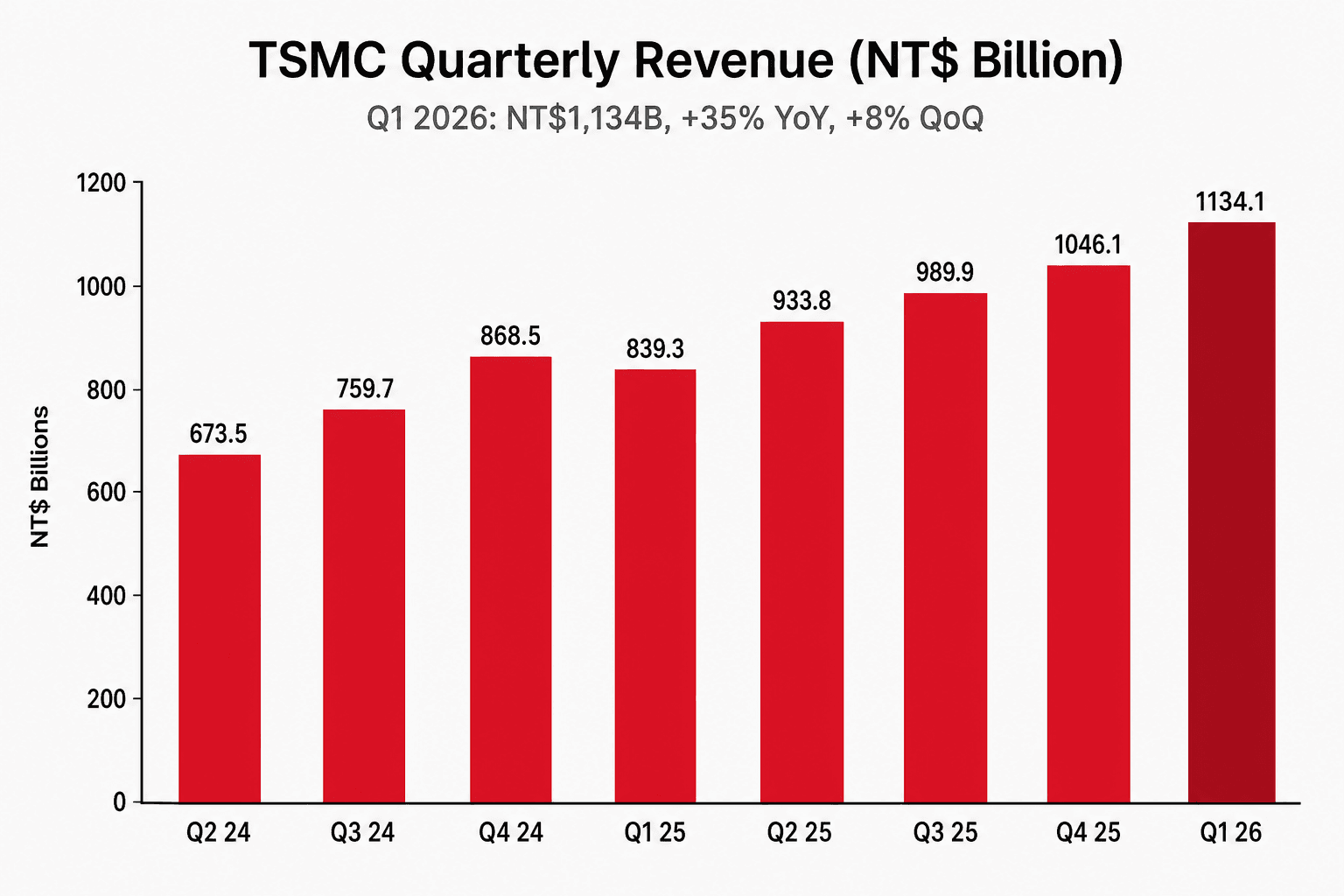
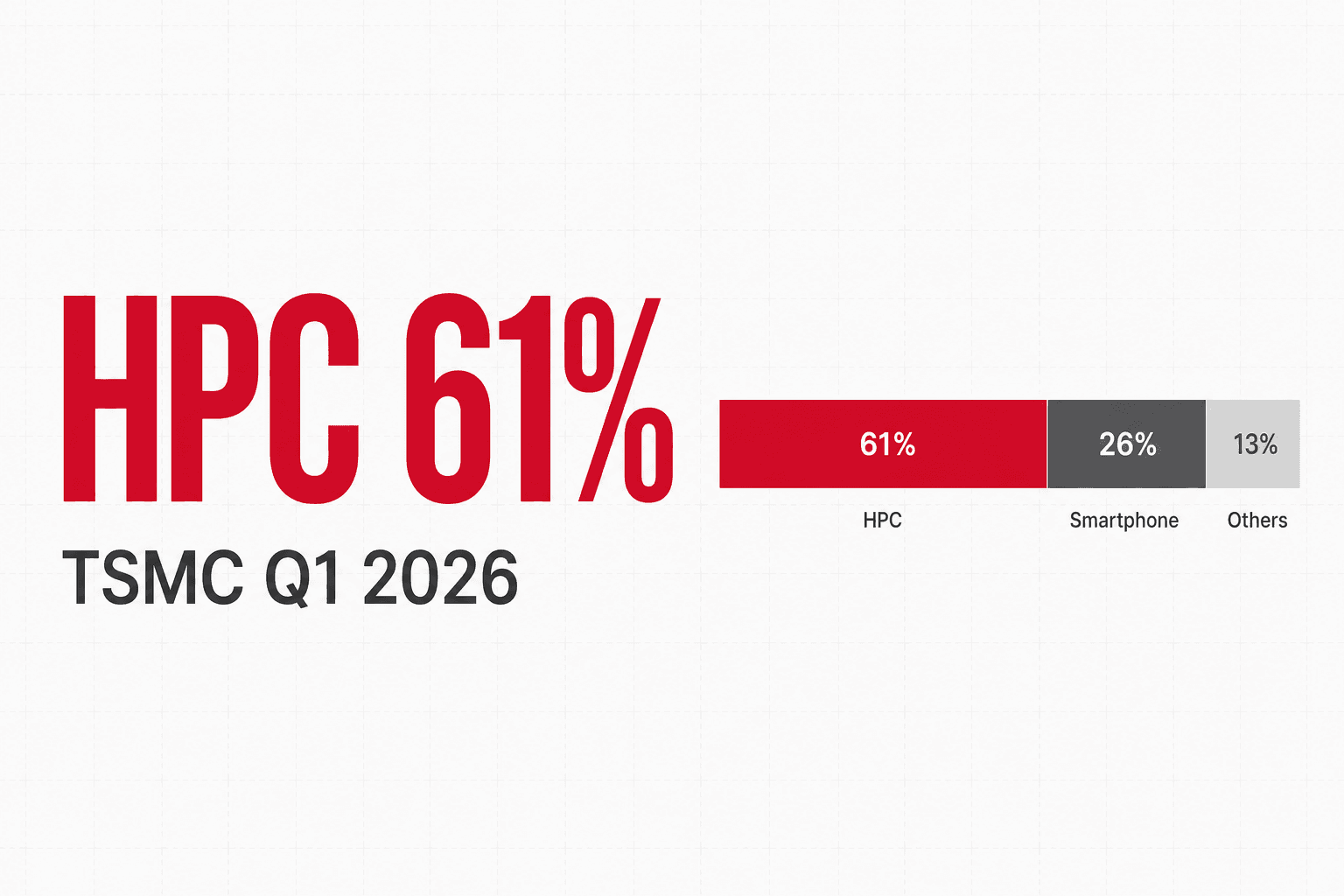
The reversal didn't come from smartphone strength — smartphone revenue still dropped -11.9% QoQ in absolute terms, exactly as expected. It came from HPC. The HPC platform mix jumped from 53% to 61% — eight points QoQ — which translates to roughly NT$691.8B of HPC revenue in Q1 2026 alone. That single number is now larger than TSMC's total company revenue in Q2 2024 (NT$673.5B).
Two years of AI demand compounding has lifted one product line above what was the entire company's top line seven quarters ago.
HPC up, smartphone down — both unusually large moves
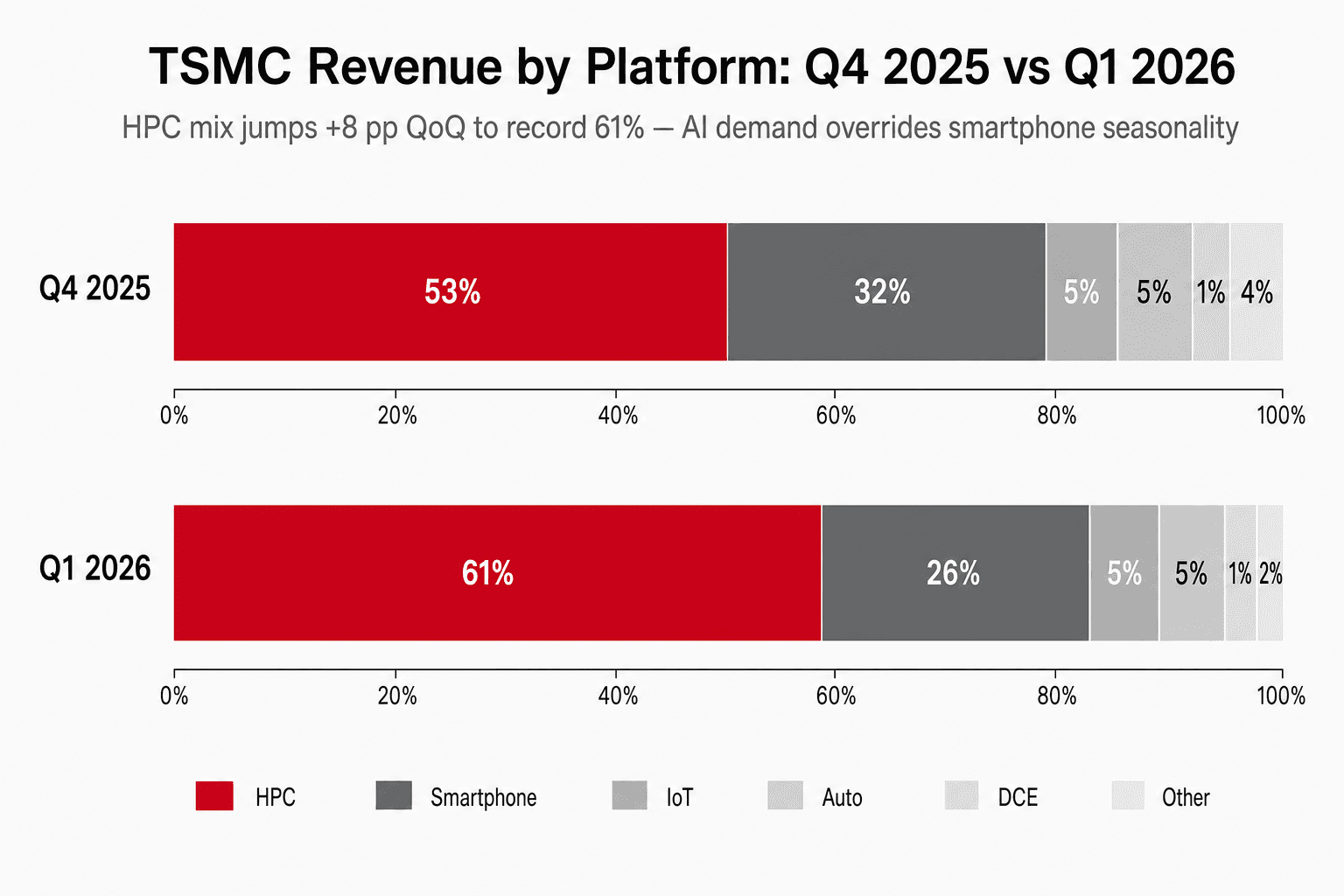
Set against the seven prior quarters, the +8 pp move isn't an isolated spike. The HPC trajectory reads: 52% (Q2 24) → 51% → 53% → 59% → 60% → 57% → 53% → 61% (Q1 26). There's quarterly noise, but the seven-quarter trend is averaging +1.3 pp per quarter.
In Q&A, when asked whether HPC had peaked, CEO C.C. Wei gave an answer worth keeping verbatim:
AI compute is driving structural demand growth that we expect to continue for at least the rest of this decade.
— C.C. Wei, TSMC Q1 2026 earnings call, 2026/04/16
He gave no upper bound. Given the early-customer composition at N2 (AI accelerators show up at N2 in materially higher proportion than they did at N3 at the equivalent stage), HPC at 65% by year-end 2026 doesn't require an aggressive assumption.
Three margins, three records: 66.2% redefines the floor
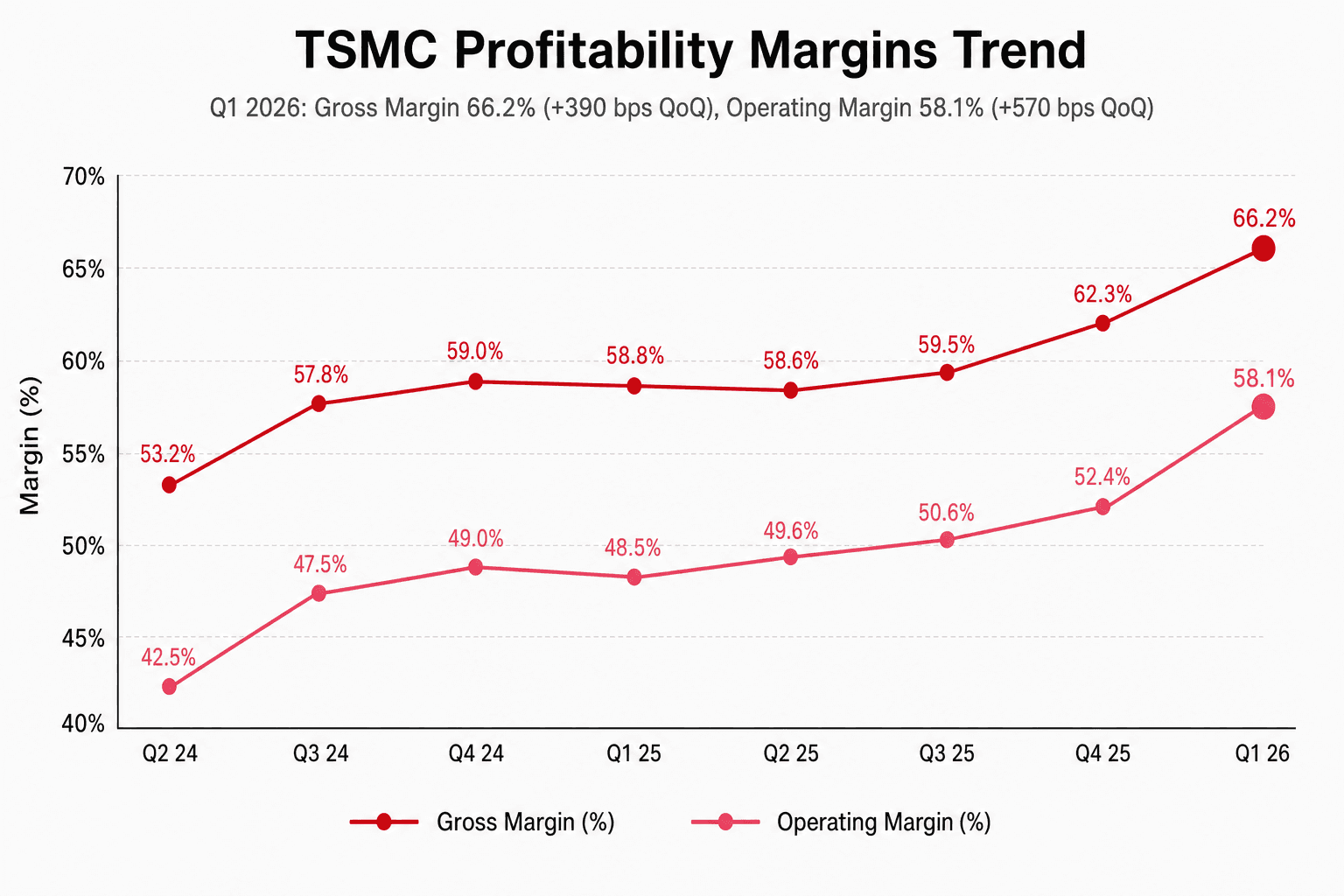
Both gross margin and operating margin printed all-time highs simultaneously. Each is more than 8 pp above the trailing 12-quarter median. This isn't "strong quarter" territory — this is "redefine the company's earnings power" territory.
CFO Wendell Huang attributed the expansion to three stacking factors: (1) overseas-fab GM drag has stabilized at 2–3 pp/year, (2) N3 yield is now mature enough that the node margin will exceed corporate average in 2H 2026, (3) N3/N5 are running fully loaded all year. None of the three pieces is new news; what's new is they all started compounding at the same time, and that timing point landed in Q1 2026.
The bigger tell is Huang's tone shift on durability. In Q2 2024 — when asked how long margin expansion could persist — he answered "we cannot guarantee." This time he answered "absent unexpected FX or input cost shocks, this should persist through 2026." That wording shift, from "we can't guarantee" to "this should persist absent shocks," is itself a signal independent of the numbers.
The "53% structural floor, 56%+ achievable" long-term language is unchanged. But at a 66.2% read-through, that language now reads as a deeply conservative floor, not an optimistic scenario.
Full-year guide up, AI accelerator CAGR up by ten points
Two guides got raised on the same call, one in the prepared remarks, one in Q&A:
Full-year 2026 USD revenue growth: raised from "approaching 30%" (the Q4 2025 framing) to "above 30%." Huang clarified the actual number "should land in the low-30s percent range." The corresponding NT$ growth rate runs higher because TWD has weakened from 31.45 at year-start to 31.78.
2024–2029 AI accelerator revenue 5-year CAGR: raised from 45% to 54–56%. This is the third upward revision in 18 months — mid-40s at the 2024 European Tech Symposium, "around 45%" at Q3 2025, now 54–56%. The new number implies AI accelerator revenue scaling from ~$20B in 2024 to ~$180B in 2029.
Wei framed the rationale around a single phrase:
The shift from generative AI and the query mode to agentic AI and the command and the action mode is leading to another step up in the amount of tokens being consumed. This is driving the need for more and more computation, which supports the robust demand for leading-edge silicon.
— C.C. Wei, TSMC Q1 2026 earnings call
"Another step up in tokens" is the keyline of the call. It reframes AI demand growth from "linear" to "stepwise" — each new application paradigm (generative → agentic → next) creates a discontinuous jump in compute requirements. If that framing is right, 54–56% may still be conservative. Bernstein's Mark Li wrote that the actual CAGR could land in the low-60s%.
CoWoS is still the binding constraint in 2026
About eight minutes of Q&A clustered around CoWoS. Sell-side asked the same question in different forms: when does supply catch up?
Wei's answer was two quantitative commitments and one unchanged limitation:
- 2026 CoWoS capacity will double vs. 2025.
- 2027 CoWoS capacity will double again vs. 2026.
- "Demand still far exceeds what we can supply."
This is the single binding constraint across the entire AI accelerator supply chain. NVIDIA, AMD, Alchip (designing Amazon Trainium), Broadcom (designing Google TPU) — all of them ultimately throttle to the CoWoS allocation TSMC can hand them. Q1 2026 saw +57% AI accelerator demand growth get capped by supply. TSMC shipped what it could build.
The clean second-order beneficiary is ASE (3711.TW) and the broader OSAT cohort — when CoWoS doubles, the back-end test demand for advanced packaging doubles with it. ASE was up +3.4% in the first session after TSMC's print; Alchip was up +5.1%. Both are direct reads on the CoWoS commentary.
Risks
Three things in this report look bullish, but each carries an independent risk:
(1) Overseas-fab execution. Arizona Phase 3 (N2/A16) committed earlier than planned, Kumamoto Fab 2 breaking ground — these will add GM drag in 2027–2028. Management's "2–3 pp annual drag" commitment covers the magnitude, but execution risk persists, especially Arizona labor cost and yield learning curve.
(2) Customer concentration. HPC growth is meaningfully concentrated in a small number of customers — sell-side estimates put NVIDIA alone at 25–35% of HPC mix. TSMC doesn't disclose customer names, but that range means any order adjustment is non-linear in the consolidated P&L.
(3) FX. The gap between +40.6% USD YoY and +35.1% NT$ YoY (a 5.5 pp delta) is mostly explained by TWD weakening from 31.45 to 31.78 in a month. If TWD strengthens in 2H 2026, the USD headline growth rate will naturally compress — not a fundamental change, but a headline-pressure event.
Why this is the most important AI earnings print of 2026
TSMC's Q1 2026 isn't just "beat guidance." It delivers structural signals on three axes:
- AI demand outweighs smartphone seasonality. A +8.4% QoQ Q1 is accounting evidence that AI demand has crossed the threshold from cyclical to structural at TSMC.
- Margin floor redefined. 66.2% gross + 58.1% operating turn the long-term targets from "optimistic case" into "conservative floor."
- AI CAGR raised by 10 pp. The 45% → 54–56% jump isn't a tweak; it's a recalibration of the growth function itself.
For any AI semis thesis, TSMC is the cleanest proxy on the supply side. Q1 2026 confirms the proxy is still accelerating, and management for the first time used "absent unexpected shocks, this should persist through 2026" to describe margin expansion. In recent sell-side memory, this is the most bullish TSMC call.
Is the optimism overdone? The three risks are still on the table. But if you had to collapse "the single most important supply-side AI earnings report of 2026" into one company, this is it.