Hon Hai Q2 2026: Cloud & Networking Crosses 50% for the First Time, Operating Income Up 68% to a Record Quarter
A quarter where AI servers passed the iPhone
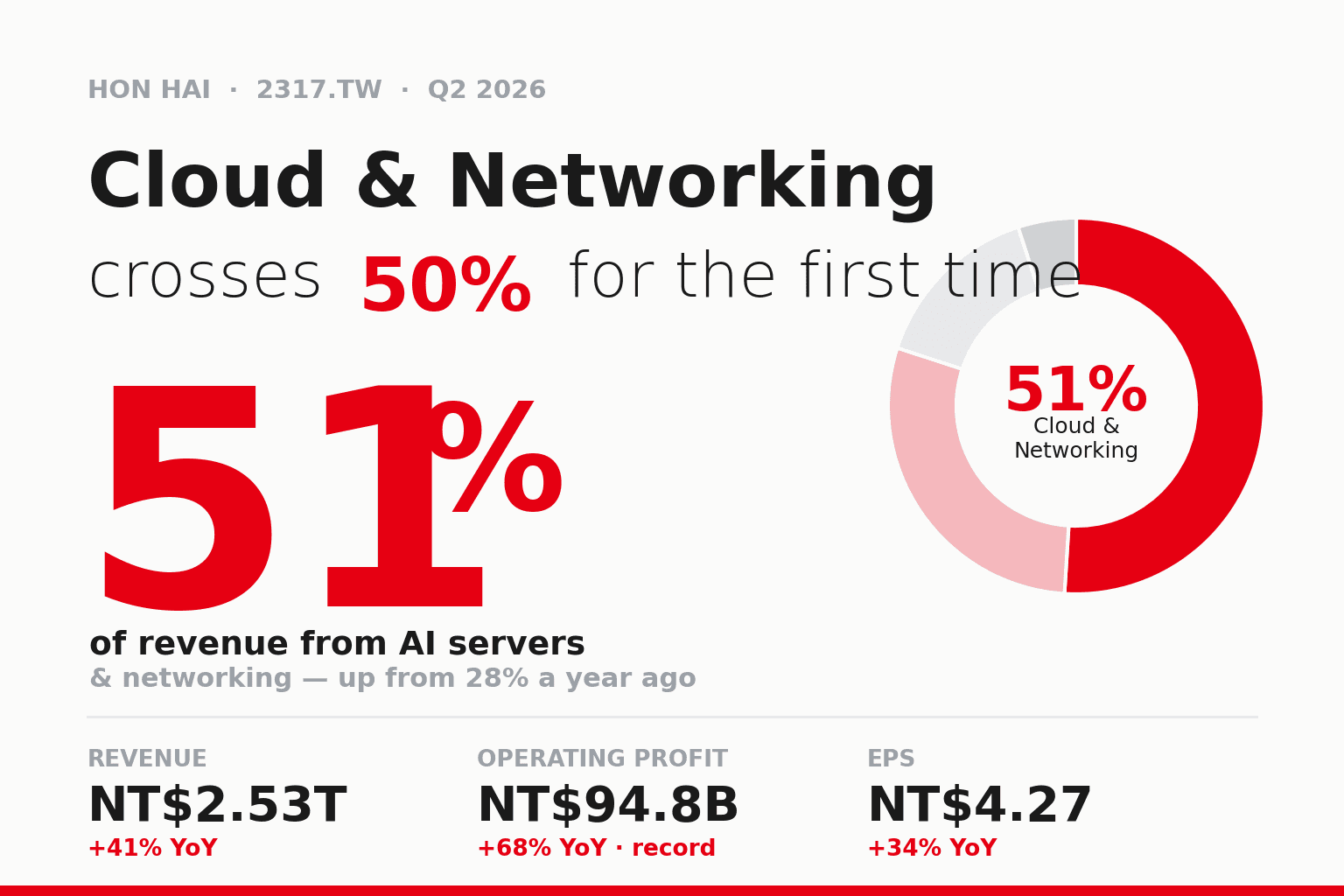
Hon Hai's (2317.TW) second-quarter 2026 revenue was NT$2.53T, up 41% YoY and 18.5% QoQ — a record for the period. EPS was NT$4.27, up 34% YoY (versus NT$3.19 a year ago and NT$3.56 the prior quarter), and net income was NT$59.97B, up 35% YoY — both also second-quarter records. These are already very good numbers, but they are not the most important thing in this report.
The most important thing is that the revenue mix crossed a symbolic line for the first time.
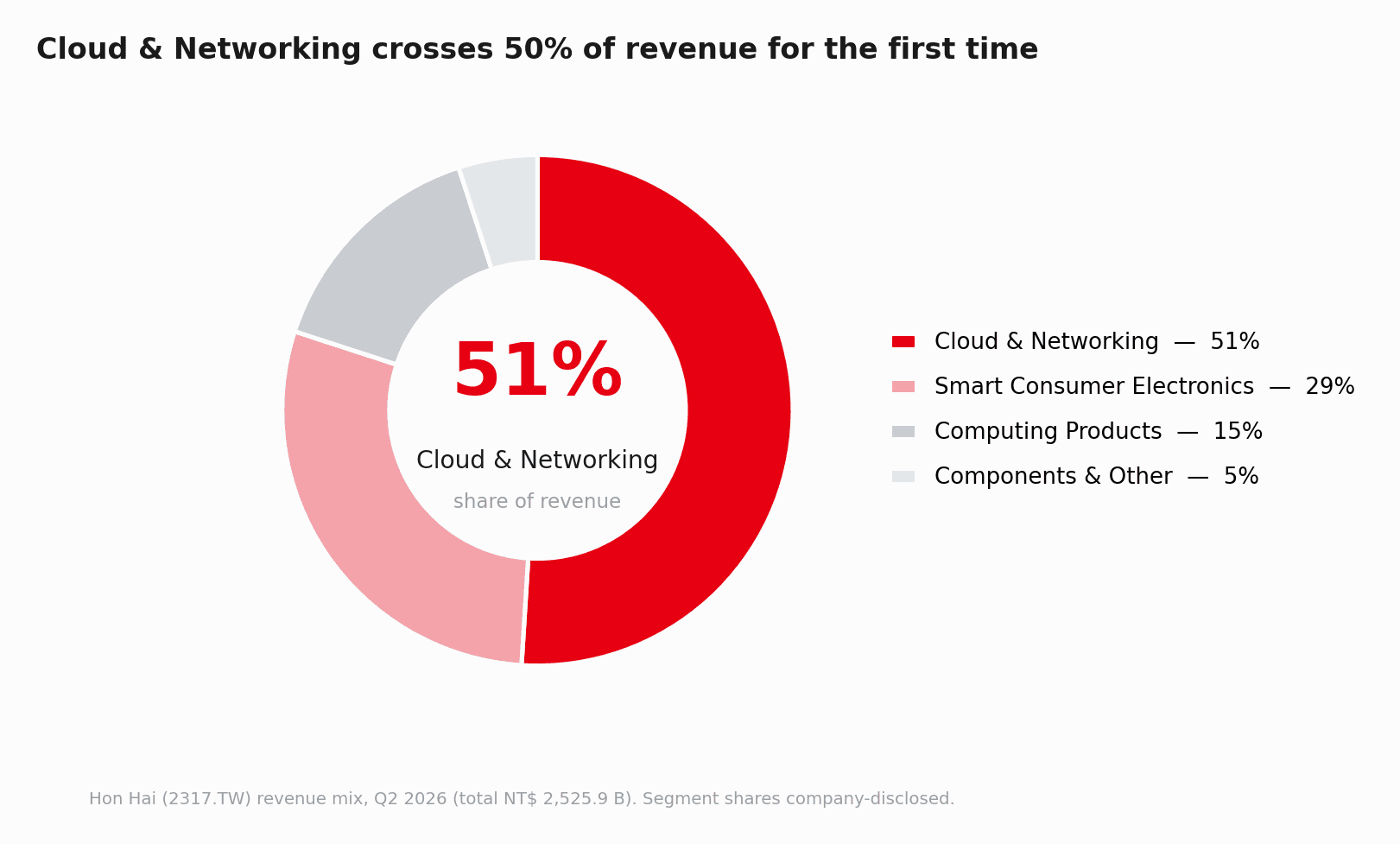
Cloud & Networking (AI servers and networking) made up 51% of revenue, up 11 percentage points sequentially; Smart Consumer Electronics was 29%, Computing Products 15%, and Components & Other 5%. In absolute terms, Cloud & Networking was about NT$1,288B, up roughly 156% YoY and 51% QoQ. It means that, for the first time, what Hon Hai earns from AI servers and networking exceeds the iPhone plus every other consumer-electronics line combined. This quarter's +41% revenue and +68% operating income were carried almost entirely by this one segment.
From 28% to 51% in a single year
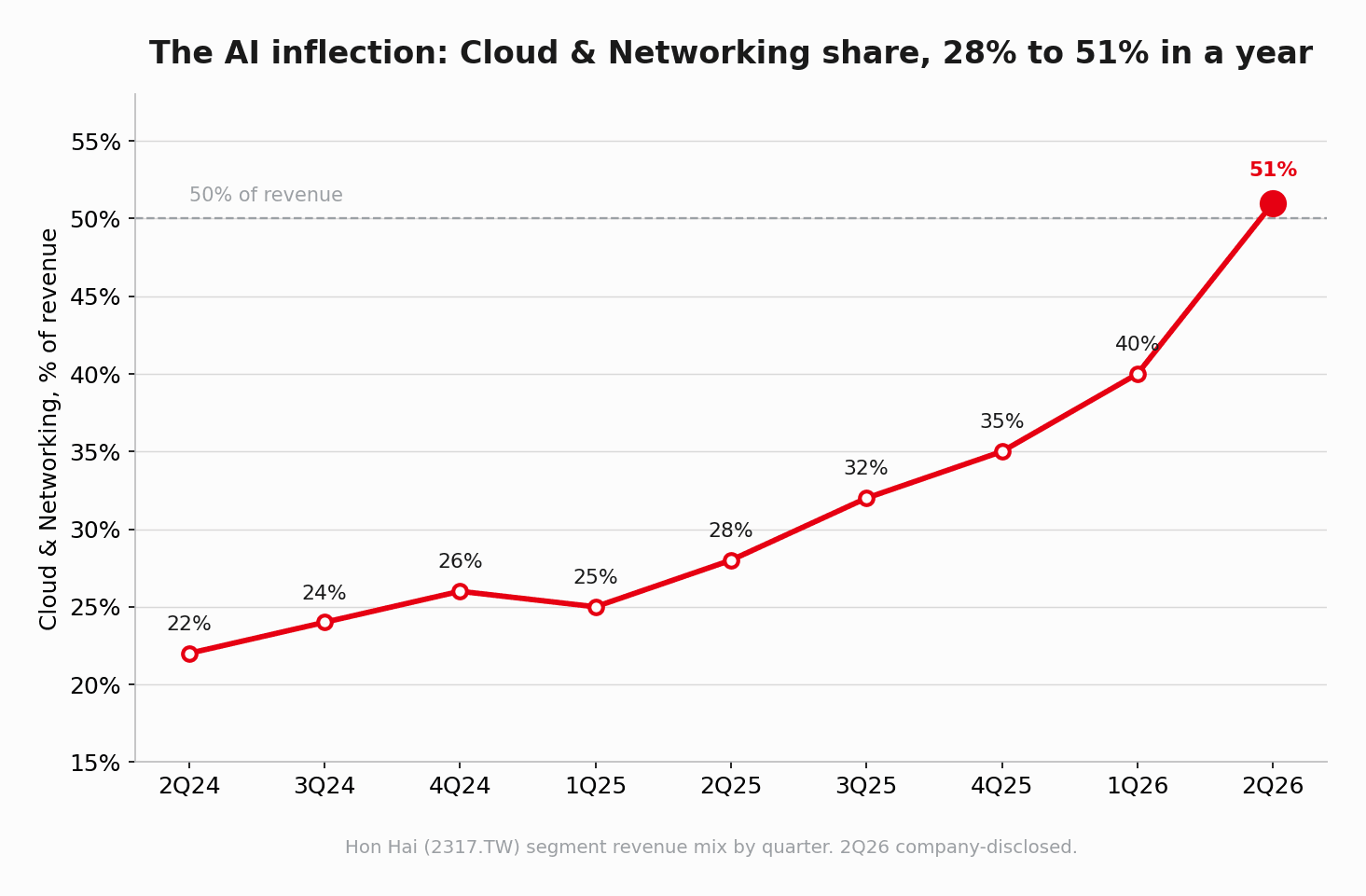
Stretched over time, the slope of this turn is steep: 22% in 2Q24, still just 28% in 2Q25 a year ago, 40% last quarter in 1Q26, and a jump straight to 51% this quarter. The share has nearly doubled over the past year. This is not a gentle penetration but a structural inflection — in a very short span, the sheer volume of AI racks shifted the center of gravity of the entire income statement.
Revenue +41%, operating income +68%: operating leverage
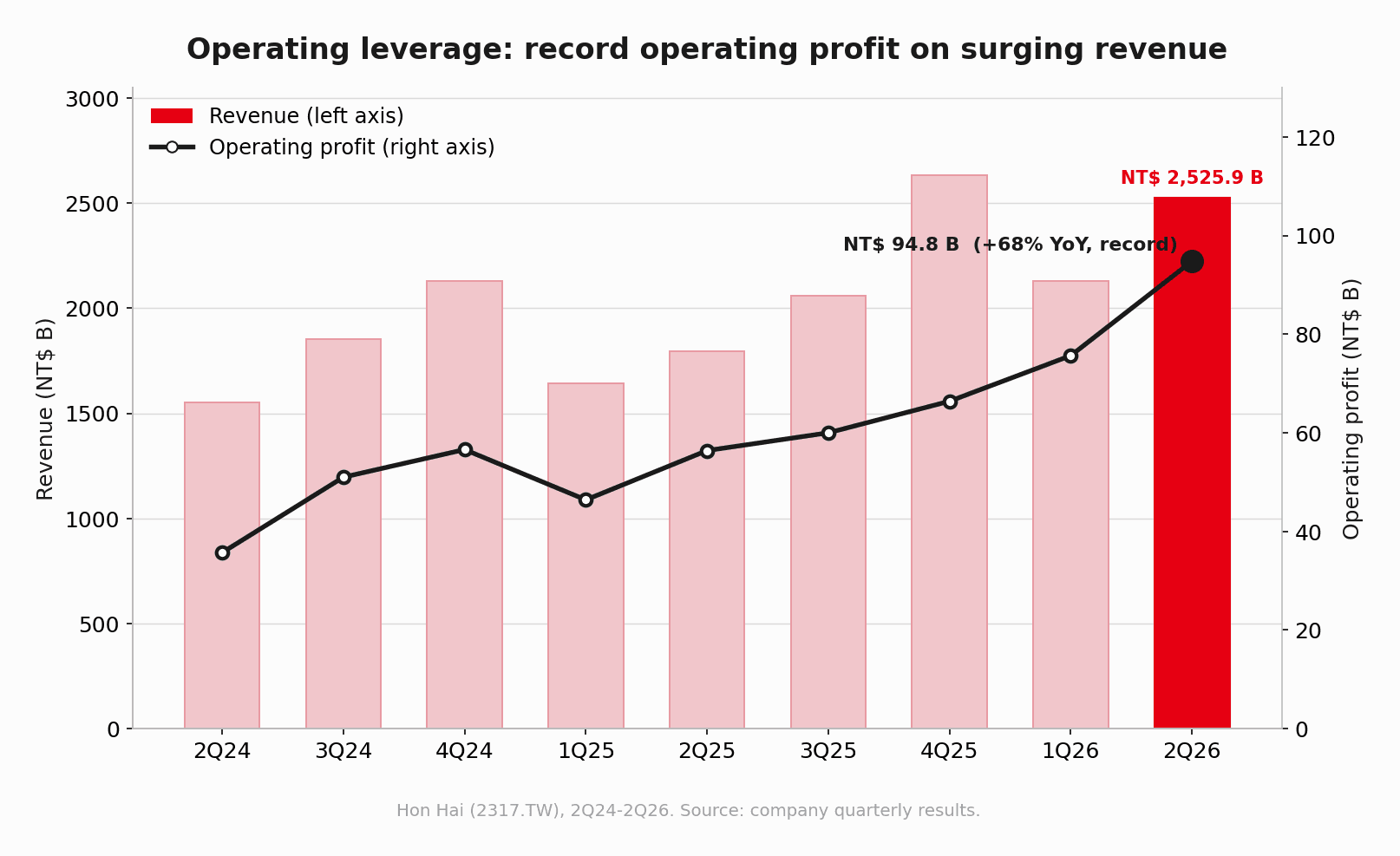
The gap between "+41% revenue" and "+68% operating income" is not accounting sleight of hand but genuine operating leverage. Operating income was NT$94.8B, up 68% YoY and 25.3% QoQ — an all-time quarterly high (the prior peak was NT$66.4B in 4Q25). The mechanism is simple: Cloud & Networking is a business of large per-order values and high line utilization, and when it ramps, operating expenses barely move — this quarter OpEx rose only about 5% while revenue grew 41%, so most of the extra contribution dropped straight into operating income. First-half operating income was NT$170.5B, up 65% YoY, and cumulative EPS reached NT$7.84 (versus NT$6.23 a year ago) — meaning half a year already banked well over half of a full year's strong showing.
Gross margin holds at 6.12%
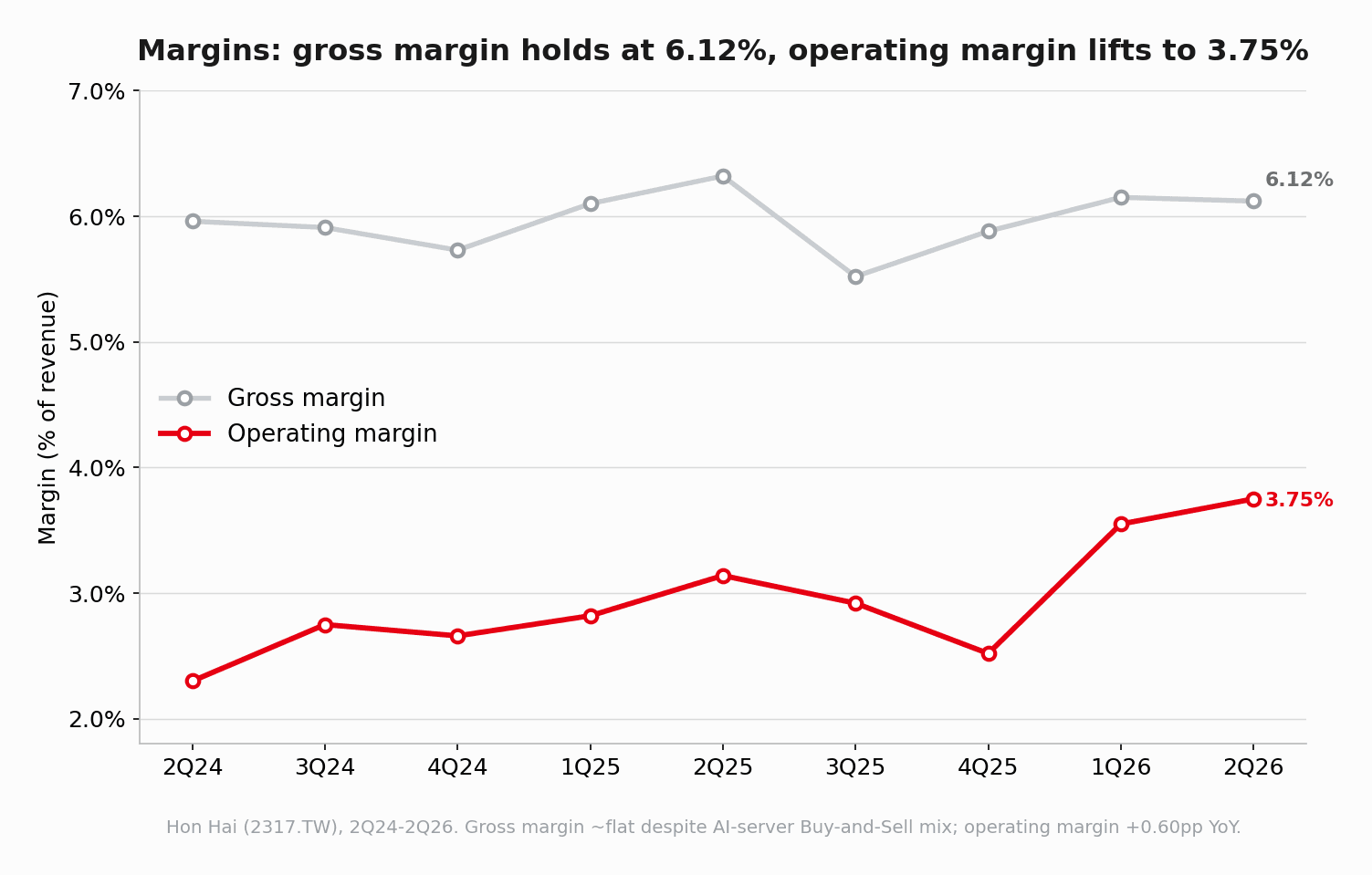
Gross margin was 6.12%, down about 0.03 points QoQ and 0.21 points YoY. Against Cloud & Networking surging to 51% of the mix, holding nearly flat is actually good news — because AI servers rely heavily on the "Buy & Sell" model (customer-supplied GPUs and HBM pass through revenue at cost with no markup), which inherently dilutes gross margin. Management's framing is clear: the benefit from AI so far shows up in revenue scale and operating efficiency, not yet in gross margin. What is genuinely lifting profit is the operating margin of 3.75%, up 0.60 points YoY; the first-half figure of 3.67% already exceeds last year's full-year 3.2% and beats the company's long-term target of 3%-plus. The next thing to watch is whether higher-value links — liquid cooling, ASIC contract manufacturing, data-center services — can push gross margin past 6.2%.
The tension beneath the print: free cash flow turns negative
The single line in this report that deserves the closest reading is this: earnings hit a record, yet free cash flow was negative. First-half operating cash flow was a net outflow of NT$69.1B; after NT$80.9B of CapEx (up 5% YoY), first-half free cash flow came to roughly -NT$150B, wider than a year ago.
The cause is not deteriorating operations but the extreme working-capital intensity of the AI-rack business. Versus a year ago, receivables rose 47%, inventory 46% and payables 52% — all cash fronted to absorb the surge in rack procurement and shipments. In other words, AI-server growth is real and profitable, but until the cash comes in, it burns cash faster than it collects.
Is this a worry? On the balance sheet, no. Hon Hai holds about NT$1.52T in cash and short-term deposits, NT$219.8B of net cash, a debt ratio of 62% and an A- rating maintained by S&P, and it has explicitly stated there is no plan for a cash capital raise; the cash conversion cycle even shortened from 48 days a year ago to 42 days. The balance sheet can carry this build-out comfortably. This is a metric to watch from here, not a reason to panic now — if collections begin in the second half and cash flow turns positive, the bull story only gets stronger; if the expansion keeps consuming cash, the pace will have to be reassessed.
Outlook: "strong growth" maintained, CapEx raised
What stands out is the mix of stances management struck this time: the full-year outlook was kept at "strong growth" and not formally raised, yet at the same time full-year CapEx was lifted to more than 30% YoY (directed at racks, liquid cooling and test capacity). The target of "more than double" full-year AI-rack shipments was left unchanged, with 3Q26 rack-shipment guidance of a "high double-digit percentage" QoQ increase. The guidance framing did not move, but adding to CapEx is usually a signal of greater confidence in order visibility for 2H26 and 2027.
A few forward highlights: July monthly revenue was NT$946.5B, up 54.2% YoY — an all-time monthly record and the first time above NT$900B — and it came before second-half ICT peak-season demand had really begun to ramp. The product lineup is also broadening: the next-generation Vera Rubin racks enter production preparation in 3Q26, begin shipping in 4Q26 and become mainstream in 2027; ASIC servers are rising as a share of AI-server revenue from about 10% in 2025 toward a target of roughly 40% (largely via contract manufacturing, so reported revenue understates the real scale); switches at 800G and above are pushing to roughly double full-year revenue, CPO all-optical switches ramp from 3Q26, and management estimates the optical-communications market could reach hundreds of billions of US dollars.
Sell-side ratings are lopsidedly bullish with no downgrades, but price targets diverge widely:
| Firm | Rating | Price Target |
|---|---|---|
| Morgan Stanley | Overweight | NT$444 (bull case) |
| Goldman Sachs | Buy | NT$400 |
| Citi | Buy | NT$360 |
| Nomura | Positive | NT$352 |
| HSBC | Positive | NT$330 |
| UBS | Buy | NT$320 |
| JPMorgan | Overweight | NT$310 |
| Local institutions (post-call) | Buy | NT$330–370 |
(Most foreign targets are pre-call levels already on the books; UBS's 7/22 update to NT$320 is the most recent. The 12-month consensus averages about NT$312.78, range NT$245–444.)
Reading the print
Hon Hai's 2Q26 can be summed up in a single line: this is the quarter the "AI EMS" thesis went from forecast to fact. Cloud & Networking crossed 50%, operating income set a quarterly record up 68% YoY, EPS hit a second-quarter high, and first-half EPS of NT$7.84 already banked well over half of a full year's strong showing.
But this report carries an asterisk that must be read alongside it: the same rack volume that pushed the income statement to new highs also dragged first-half free cash flow into the red. This is not bad news but the price of growth — the real question is whether second-half collections can catch up with shipments. Management held guidance and added to CapEx, in effect saying through its actions that order visibility has improved; the market responded positively too. The remaining checkpoints are concrete: whether monthly revenue can keep setting records, whether Cloud & Networking can hold 51%, whether gross margin can break above 6.2%, and when free cash flow turns positive. Those four things will decide whether the 51% milestone is the start of a new normal or the high point of a single quarter.