Tesla's Q1 2026 Margin Rebound Is Real — But the $25B CapEx Bill Is the Real Story
The headline print was clean
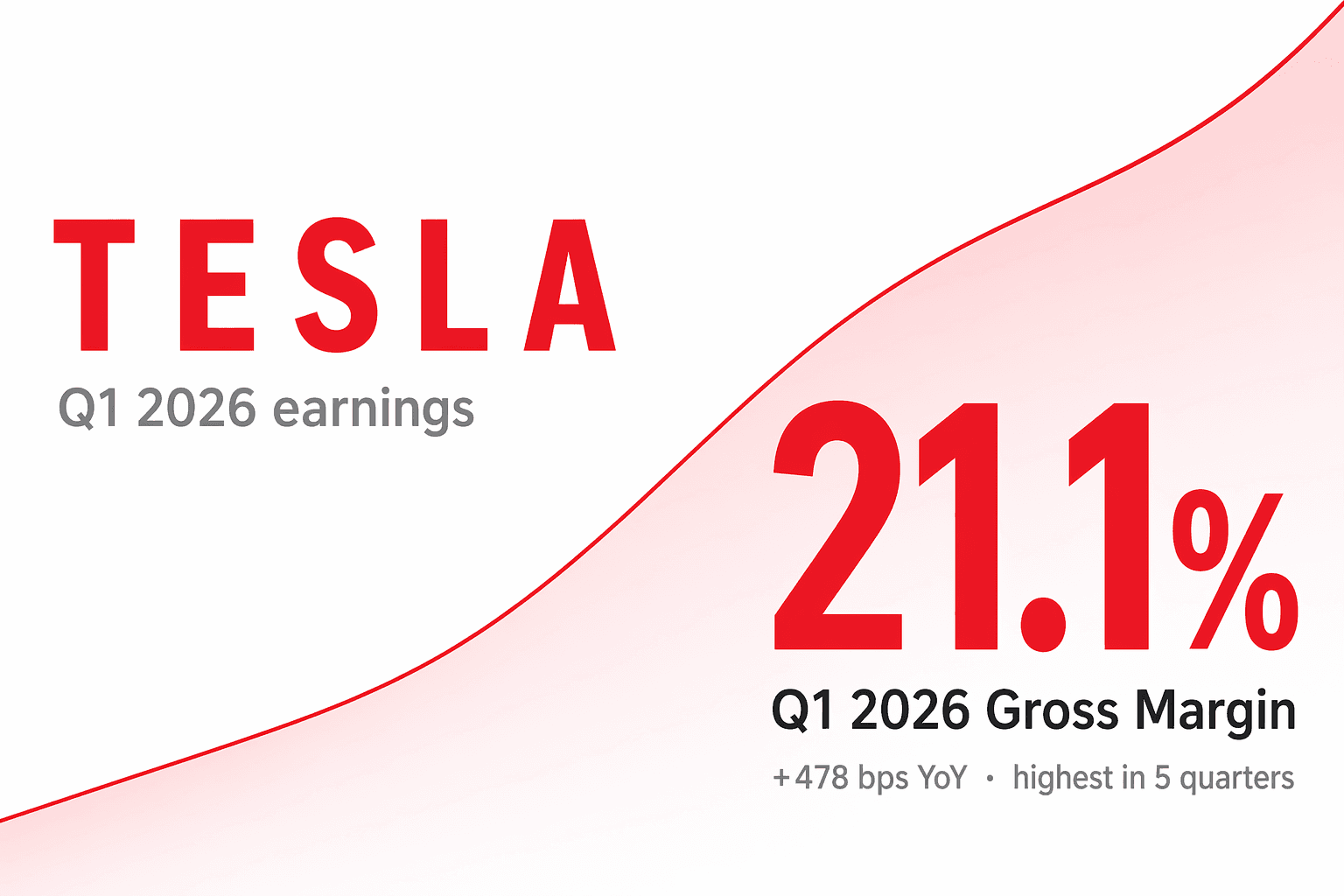
By every number that matters to a quarterly scorecard, Tesla delivered the best Q1 it has printed in five quarters. Revenue of $22.4B was up 16% YoY. GAAP gross margin hit 21.1% — a 478 bps YoY expansion and the highest since Q3 2024. Non-GAAP diluted EPS came in at $0.41 against consensus of roughly $0.36-0.37. Free cash flow, which the Street had modeled at negative $1.57B, landed at positive $1.44B — a swing of $3B relative to expectations.
If you screened Tesla's Q1 2026 on a finance terminal, everything was green.
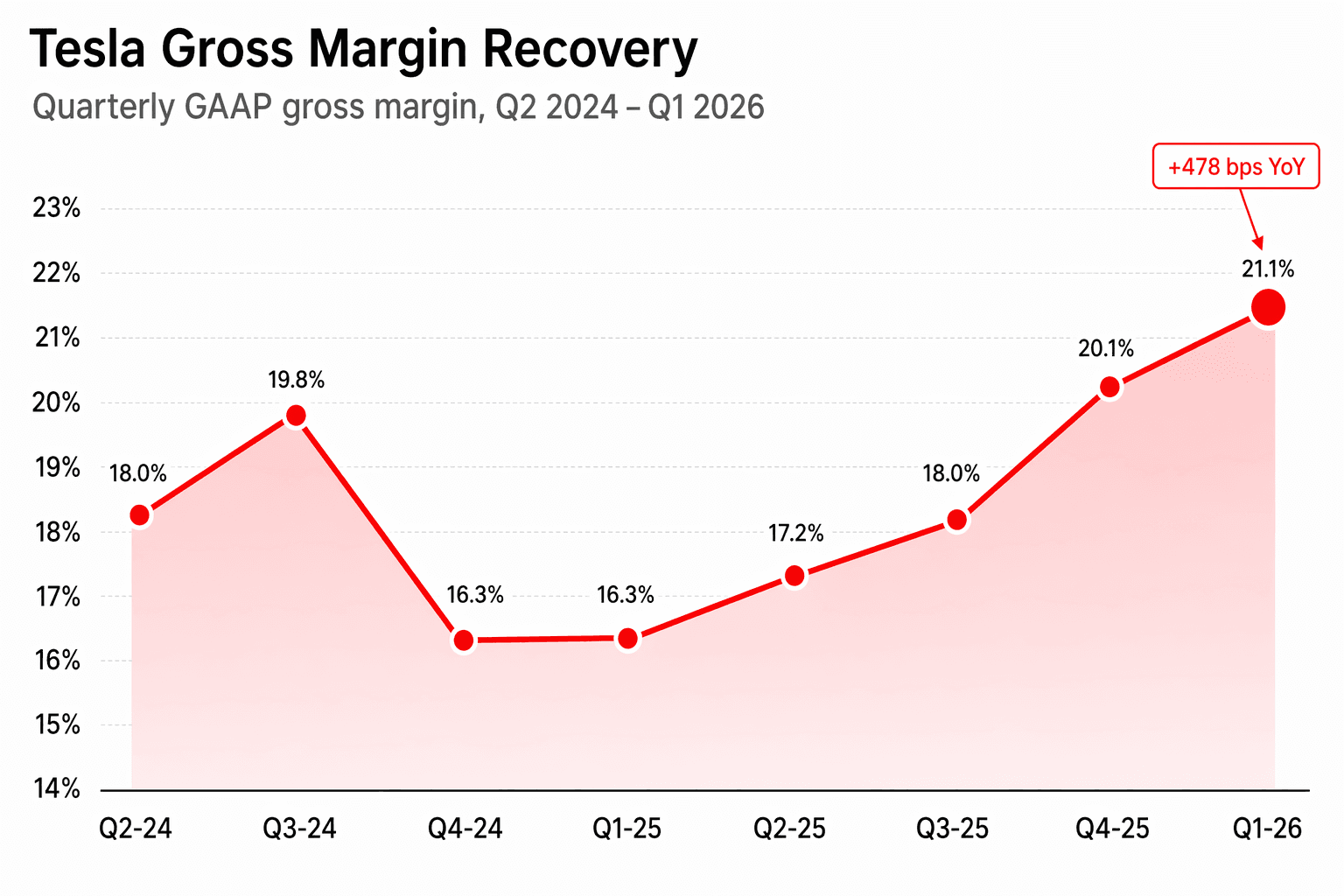
The margin story is not just the headline percentage — it is the shape of the curve. Gross margin bottomed at 16.3% in Q4 2024 / Q1 2025, exactly when the Model Y refresh ("Juniper") cost the company its highest-mix production line across four factories. It has recovered every single quarter since, driven by a combination of lower raw-material costs, the end of Cybertruck ramp drag, disciplined incentive management in China, and — according to management's own Q1 commentary — a $0.9B FX tailwind on revenue and $0.2B on operating income.
That FX number matters. Strip it out and the beat is still a beat, but it is no longer dramatic.
Under the hood: Services & Other is the story nobody is writing about
The press has fixated on auto deliveries (down 14% QoQ, producing a ~50,000-unit inventory build) and on the energy storage miss (8.8 GWh vs. 12-14 GWh consensus). Both are real. Both are concerning.
The under-reported story is Services & Other revenue, which reached $3.75B, up 42% year-over-year and now represents 16.7% of total revenue — the highest share since Tesla began disclosing the segment.
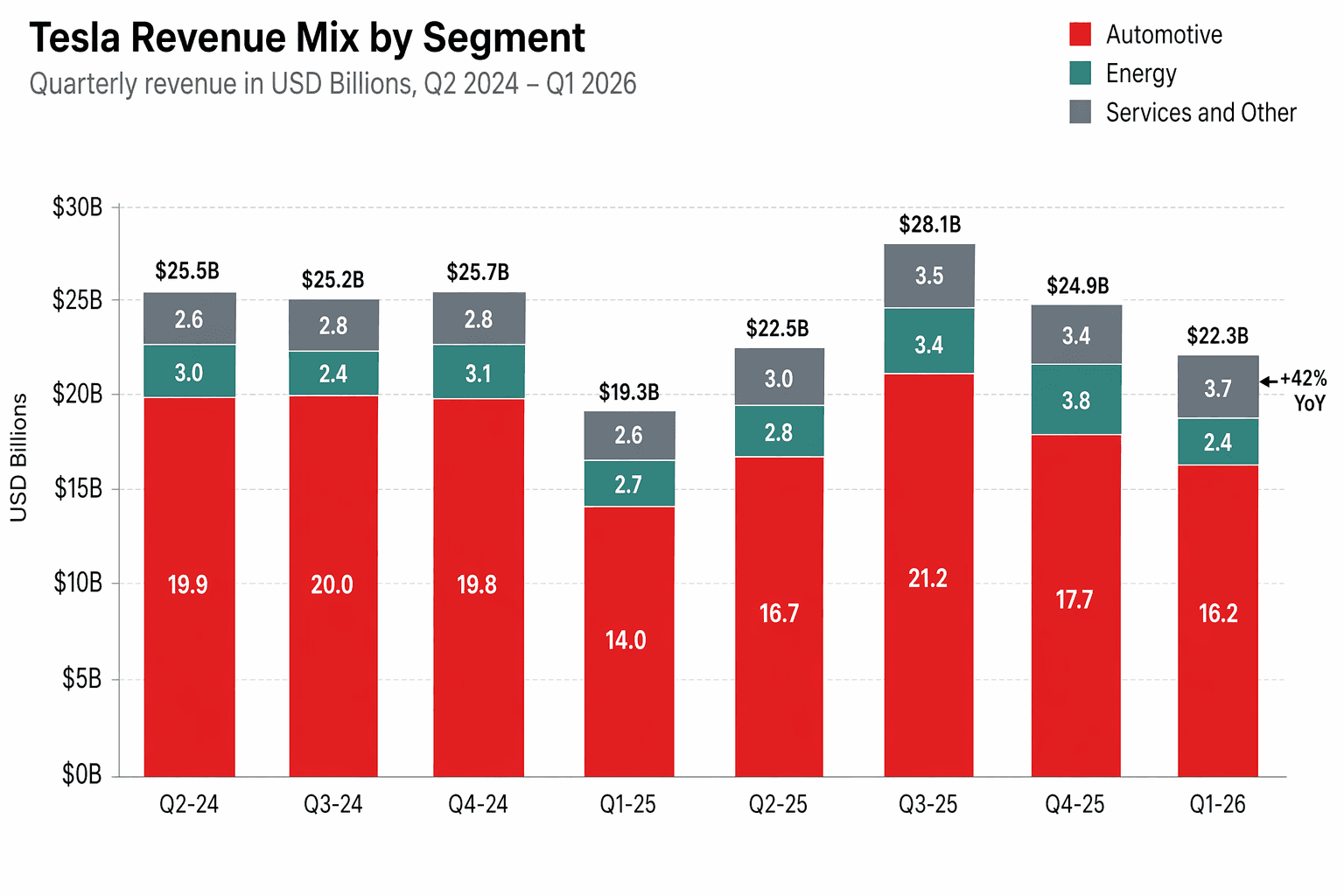
Services is a bundle of real businesses: Tesla Insurance, Supercharging revenue (including third-party access), used-vehicle sales, collision repair, and increasingly FSD-attached insurance discounts. When Musk said on the call that Tesla now issues a Safety Score of 100 to every mile driven with FSD (Supervised) — and that insurance premium reductions "can more than compensate for the monthly price of FSD" — he was describing a flywheel. FSD subscribers get cheaper insurance; cheaper insurance raises FSD attach rate; higher attach rate expands the training dataset; the training dataset makes the autonomy product better; and somewhere along the way, all of that revenue lands in the Services line.
Active FSD subscriptions reached 1.28M, up 51% YoY and 16% QoQ. That growth rate is faster than any other KPI Tesla disclosed this quarter.
The real story: CapEx just went up by $5B
Here is what the market actually reacted to. During the earnings call, CFO Vaibhav Taneja said:
"We expect capex to be more than $25 billion this year."
Last quarter's guidance was $20B. This is a $5B mid-year raise — a 25% increase — driven by four concurrent build-outs: the Optimus production line installation in Fremont, AI training compute (Cortex 2 online at >130k H100e, Cortex 3 in early ramp), the Research Fab for in-house AI5 silicon on the Giga Texas campus, and ongoing expansion of the Robotaxi fleet plus Supercharger network.
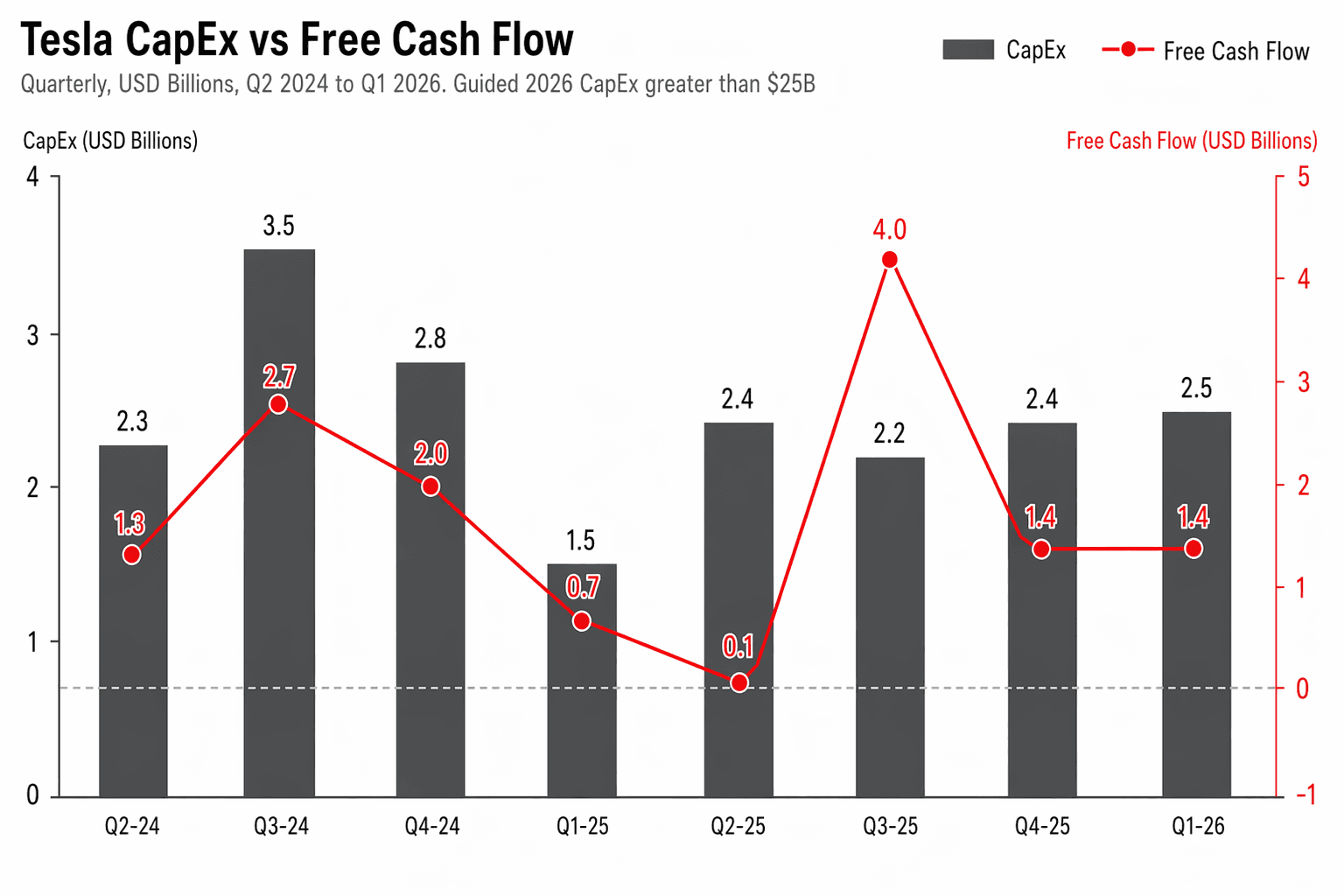
Do the arithmetic. A $25B CapEx run rate is ~$100M per day, every day, for all of 2026. In Q1 alone Tesla already spent $2.5B, up 67% YoY — so $25B implies a meaningful acceleration in Q2-Q4. Tesla's own trailing-12-month free cash flow is currently around $6.9B. If CapEx runs at $25B while the auto business is still printing 4% operating margins, FCF compression becomes the base case — not the bear case.
This is the reason TSLA finished the day down. It is not a repudiation of the margin print. It is a re-pricing of how much of 2026's earnings Tesla plans to plow back into non-auto ambitions.
Hardware 3 is a quiet liability
Buried in the Q&A, Musk said: "Hardware 3 does not have the capability" to run unsupervised Full Self-Driving.
Tesla has been selling HW3 vehicles since 2019 with language promising "one software update away from" full autonomy. There are well over a million HW3 cars in customer hands. On the call Musk promised Tesla would "make it right" — but gave no commitment on retrofit pricing, timing, or whether the expense will be paid by Tesla or billed to customers.
Three knock-on effects:
- Warranty accrual pressure: GAAP accounting will likely demand a reserve for the retrofit program once the details are public. That charge flows through gross margin — the very metric that just recovered.
- Class-action exposure in the US and collective-redress exposure in the EU, where "Full Self-Driving" marketing has been under the microscope since 2023.
- Brand & FSD-attach damage on the existing HW3 fleet, which needs to keep renewing FSD subscriptions to sustain the flywheel above.
Tesla has the balance sheet to absorb the retrofit cost — $44.7B in cash and short-term investments at quarter-end — but the accounting hit is the overhang for the next two earnings prints.
The analyst table
A snapshot of how the Street is positioned 24 hours after the print:
| Firm | Analyst | Rating | PT |
|---|---|---|---|
| Wedbush | Dan Ives | Outperform | $600 (Street-high) |
| Morgan Stanley | Adam Jonas | Overweight | $410 |
| MLQ.ai (consensus) | — | — | $459 |
| GLJ Research | Gordon Johnson | Sell | — |
Across the 60 analysts Finnhub tracks, 48% rate TSLA Buy or better, 35% Hold, 17% Sell. The dispersion tells the story: there is no consensus on what Tesla is, and every earnings print is now interpreted through whichever narrative the analyst already held. Bulls see margin rebound + Robotaxi + Optimus + Services flywheel. Bears see auto inventory build + HW3 liability + $5B CapEx raise.
Forward look
Three things to watch before the Q2 2026 print (July 2026):
- Robotaxi unit economics disclosure. Musk asserted profit-per-mile is positive in Austin. If Tesla publishes that number in Q2, the AI-platform valuation case becomes concrete. If they don't, expect continued skepticism.
- HW3 retrofit program details. The accounting treatment will show up in Q2 or Q3. Watch for a warranty-reserve change in the 10-Q.
- CapEx pacing. Q1 was $2.5B. To hit $25B full-year with the implied acceleration, Q2-Q4 need to average ~$7.5B per quarter. A Q2 CapEx print above $4B would validate the guide; below $3B would suggest the $25B number is a ceiling, not a commitment.
All figures sourced from Tesla's Q1 2026 Update (SEC 8-K filed 2026-04-22, Exhibit 99.1). Analyst quotes and market-reaction figures sourced from CNBC, Bloomberg, WSJ, Reuters, and IBD coverage of the earnings call.