ServiceNow's Q1 2026 Was a Clean Beat. Armis, Iran, and a Federal Shutdown Took the Stock Down 15%
The print was cleaner than the reaction suggests
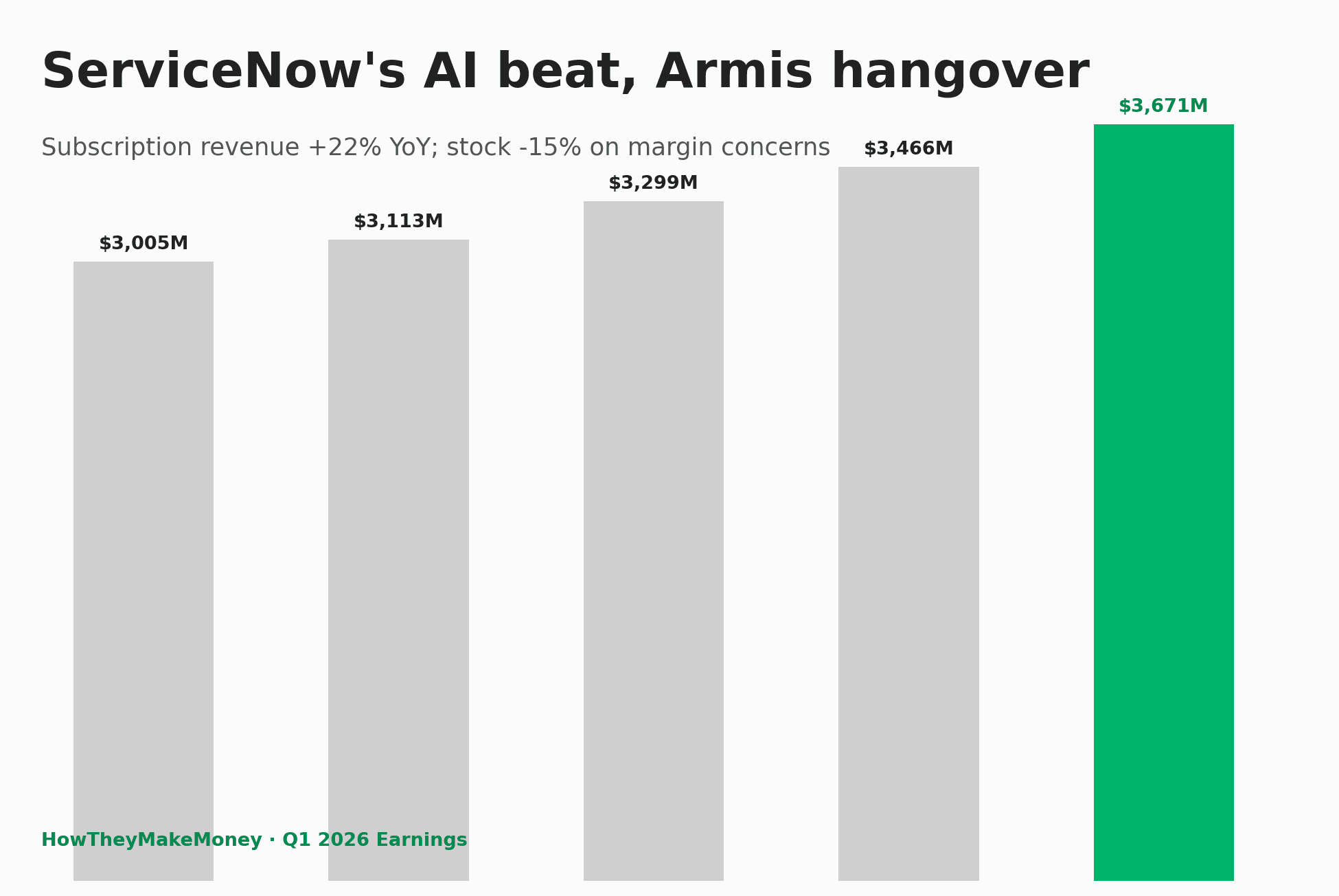
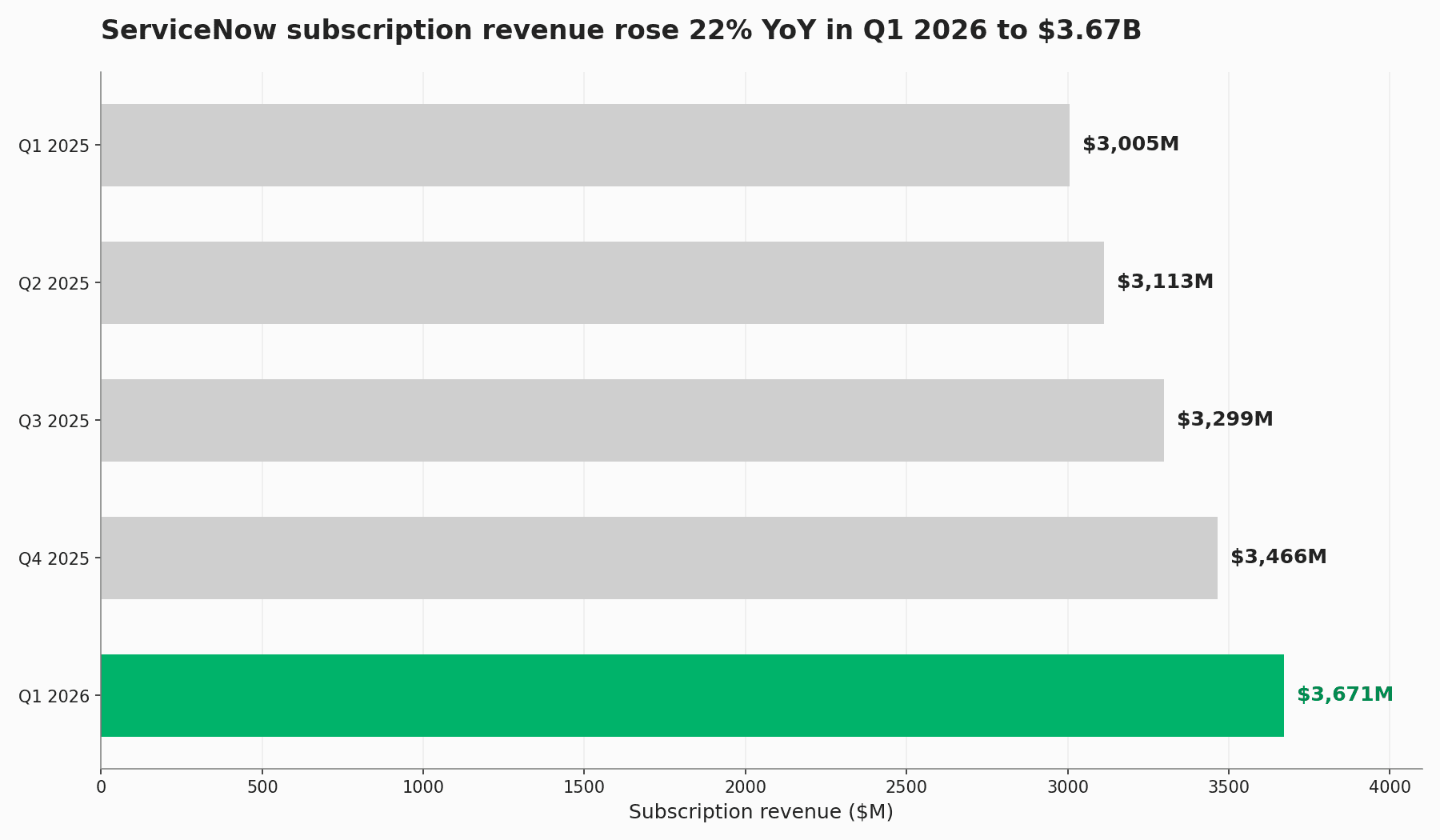
By every number that matters, ServiceNow's Q1 2026 was a beat. Revenue of $3.77B grew 21.5% year-over-year and cleared consensus by ~$23M. Subscription revenue of $3.67B grew 22.2% YoY — accelerating modestly on a reported basis even as it decelerated two points in constant currency to 19%. Non-GAAP operating margin landed at 32.0%, 50 bps above the high end of the company's own guide. Free cash flow of $1.665B translated to a 44.2% FCF margin — the highest in ten quarters. Most importantly for a SaaS platform at this scale, current remaining performance obligations (cRPO) of $12.64B beat the $12.38B consensus by $260M, even after absorbing a ~75 bps headwind from Middle East on-prem deal deferrals.
Then the stock fell roughly 15%.
The three drags that hit on the same day
This is the story nobody was modeling coming into the quarter: ServiceNow printed a beat, and it ran into three separate, fundamentally transitory drags on the same conference call. Each drag was individually defensible. Stacked together, they rewrote the Q2 and FY26 narrative in a way that the sell side had not priced in.
Armis closed Monday. ServiceNow completed its $7.75B acquisition of Armis on April 20, 2026 — two days before the print. The deal is strategically sensible: Armis sits on the asset-visibility layer that ServiceNow's CMDB has never fully owned, and the integration pitch is that CMDB + Armis + Now Security Operations finally gives customers one control plane for "asset → risk → workflow." The mechanical problem is that Armis is a ~$300M ARR business inside ServiceNow's ~$16B FY26 subscription base. It adds +125 bps to Q2 and FY26 subscription revenue growth, but it takes −75 bps out of FY26 non-GAAP operating margin and −200 bps out of FCF margin. The math was known to sell-side models, but the Q1 call made it real for the first time.
The federal vertical collapsed. Federal government orders came in at ~$48M in Q1 2026 — a 72% YoY decline, tied to the ongoing US federal shutdown. CFO Gina Mastantuono said flatly that the raised FY26 guide does not assume any recovery in federal orders. That matters because ServiceNow's federal book historically carries the highest retention and expansion rate of any vertical, and because the Q2 seasonal mix typically leans federal-heavy.
Iran-adjacent deals deferred. A ~75 bps Q1 subscription headwind came from on-premise deals in Middle Eastern markets where the Iran regional conflict pushed CIO decision timelines out by one or two quarters. Management characterized these as deferred, not lost. But the cRPO shape in Q2 will reflect that slippage.
The margin chart the market actually cared about
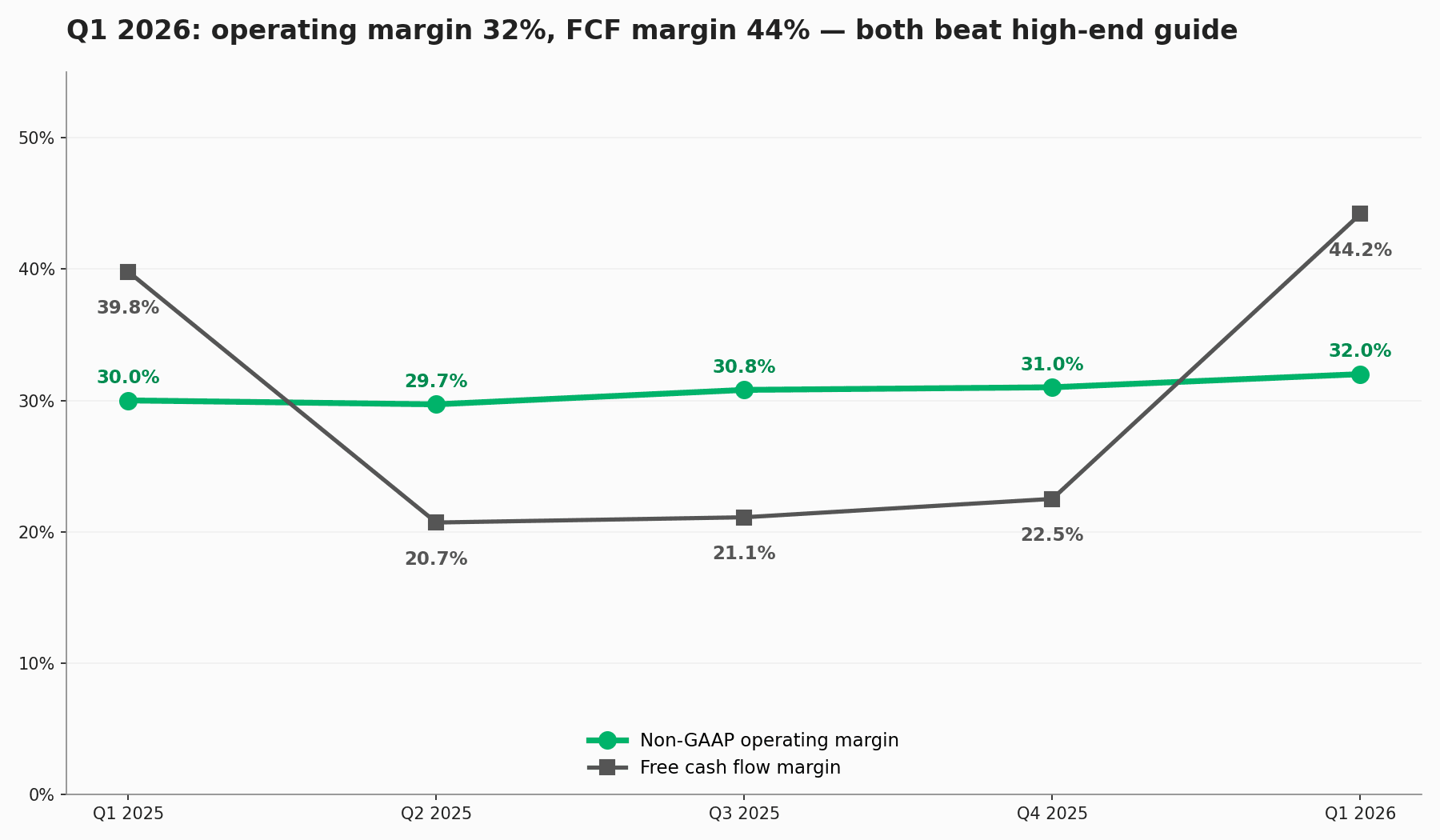
Note the shape: Q1 is the seasonally strongest FCF quarter — that is known. The operating margin line is the story. ServiceNow has now expanded non-GAAP operating margin in six of the last seven quarters, and Q1 2026's 32% is the best single-quarter print in the company's history. The market reaction was not about the print — it was about the FY26 implied trajectory, which now bakes in the Armis dilution and lands at 31.5% for the full year. That is still up 50 bps versus the prior FY26 guide, but it is flat to slightly down from Q1 — and SaaS investors price rate-of-change, not levels.
Now Assist is working — the question is how fast the monetization compounds
The underappreciated story of Q1 2026 is the Now Assist attach data. Management raised the FY26 AI commitments target from $1.0B to $1.5B — a 50% increase just one quarter into the year. CEO Bill McDermott's language was unusual for a ServiceNow earnings call: "We'll probably blow through that, too, because the acceptance of our AI solutions is just absolutely stunning."
The supporting operational data points:
- Deals with 3+ Now Assist products: +70% YoY
- Deals with 5+ Now Assist products: 36 (up from ~18 a year earlier)
- Customers committing >$1M ACV on Now Assist: +130% YoY
- Workflow Data Fabric attached to 24 of the top 100 deals in its first full quarter of general availability
The question this raises — and it is the real overhang on the stock — is whether the Now Assist attach rate accelerates fast enough to outpace the Armis margin drag before FY27. Goldman and Morgan Stanley both kept their Buy ratings and framed the current drawdown as an entry point on exactly that math. UBS downgraded to Neutral on exactly the opposite framing — that Now Assist pricing power is not yet validated by ACV expansion data, and that CSM (customer service management) growth is already decelerating.
cRPO tells a cleaner story than the stock does
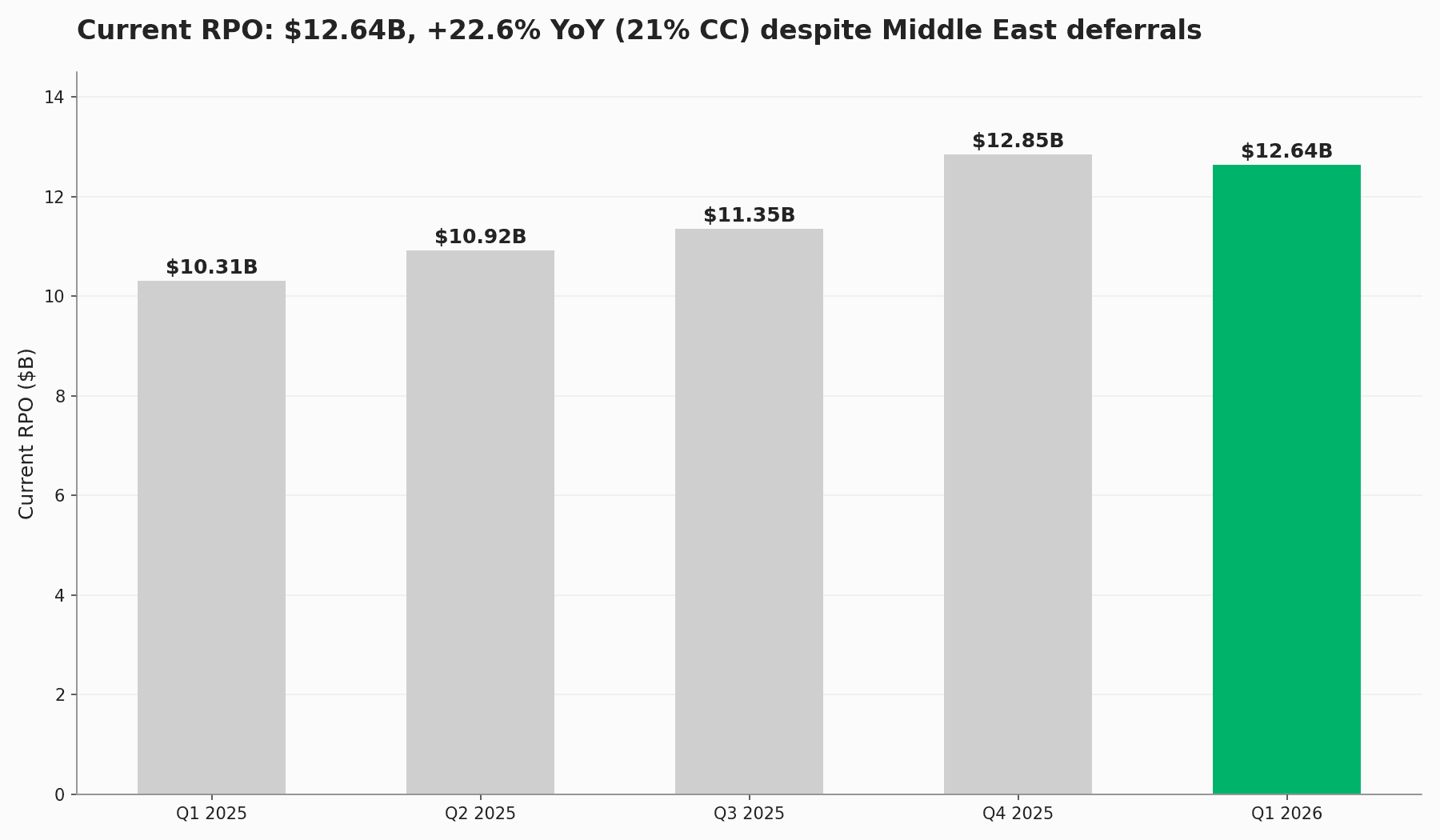
The most important number on the print, for anyone modeling forward subscription revenue, is cRPO. It dipped 1.6% sequentially from Q4's $12.85B to $12.64B — which is the normal Q1 seasonality after the Q4 renewal peak. What is not normal is that it grew 22.6% YoY on a reported basis and held 21% constant-currency growth flat versus Q4, despite the Iran-adjacent drag and the federal shutdown. That is a structurally healthy renewal book.
Total RPO of $27.7B is up 25% YoY — the fastest growth print in 18 months and a direct read on the length and depth of the enterprise AI pipeline.
Analyst reaction: PTs cut, ratings mostly held
Thirty-seven of 41 sell-side analysts cut their 12-month price target; only one (UBS) downgraded the rating. Median PT cut was ~15%. The consensus now sits at $171 versus a pre-print $202. The divergence is informative:
- Cautious: UBS (downgrade), Capital One (-29%), Baird (-29%) focus on federal drag, Middle East slippage, and Armis dilution.
- Constructive: Goldman ($220→$175), Morgan Stanley ($230→$190), Jefferies ($210→$170) argue cRPO beat + AI commitments raise + raised sub guide show the underlying demand signal is intact.
The bear case needs federal softness to be non-transitory. The bull case needs Now Assist attach rates to keep compounding. Q2's print — including the first full quarter with Armis consolidated — will settle it.
The forward setup
What I'll be watching in Q2 2026:
- Now Assist ACV step-up. The $1.5B FY26 target implies Q2 needs a quarter-over-quarter acceleration. If deals with 3+ Now Assist products slow below +70% YoY growth, the "we'll blow through $1.5B" narrative is at risk.
- Armis standalone disclosure. Will ServiceNow break out Armis contribution to subscription revenue and cRPO? If yes, it simplifies the modeling. If no, it compounds the opacity that investors were punished for today.
- Federal pipeline commentary. Even if orders don't recover, pipeline disclosure would reset the market's worst case.
- Middle East deal re-closure. The ~75 bps that deferred into Q2/Q3 should surface as a topline beat — that's the single most-watched detail for the bull case.
For now, the stock trades at its widest EV/Revenue discount to its own 10-year median. That's what Q1 2026 priced in. The question the Q2 print will have to answer is whether the AI Control Tower narrative — the one McDermott has now anchored the equity story to — is durable enough to re-rate it back.