Intel's Q1 2026: DCAI +22%, Non-GAAP Margin at a 4-Year High, and Why the 'AI CPU' Narrative Finally Has a Number Behind It
A turnaround quarter with a specific number behind it
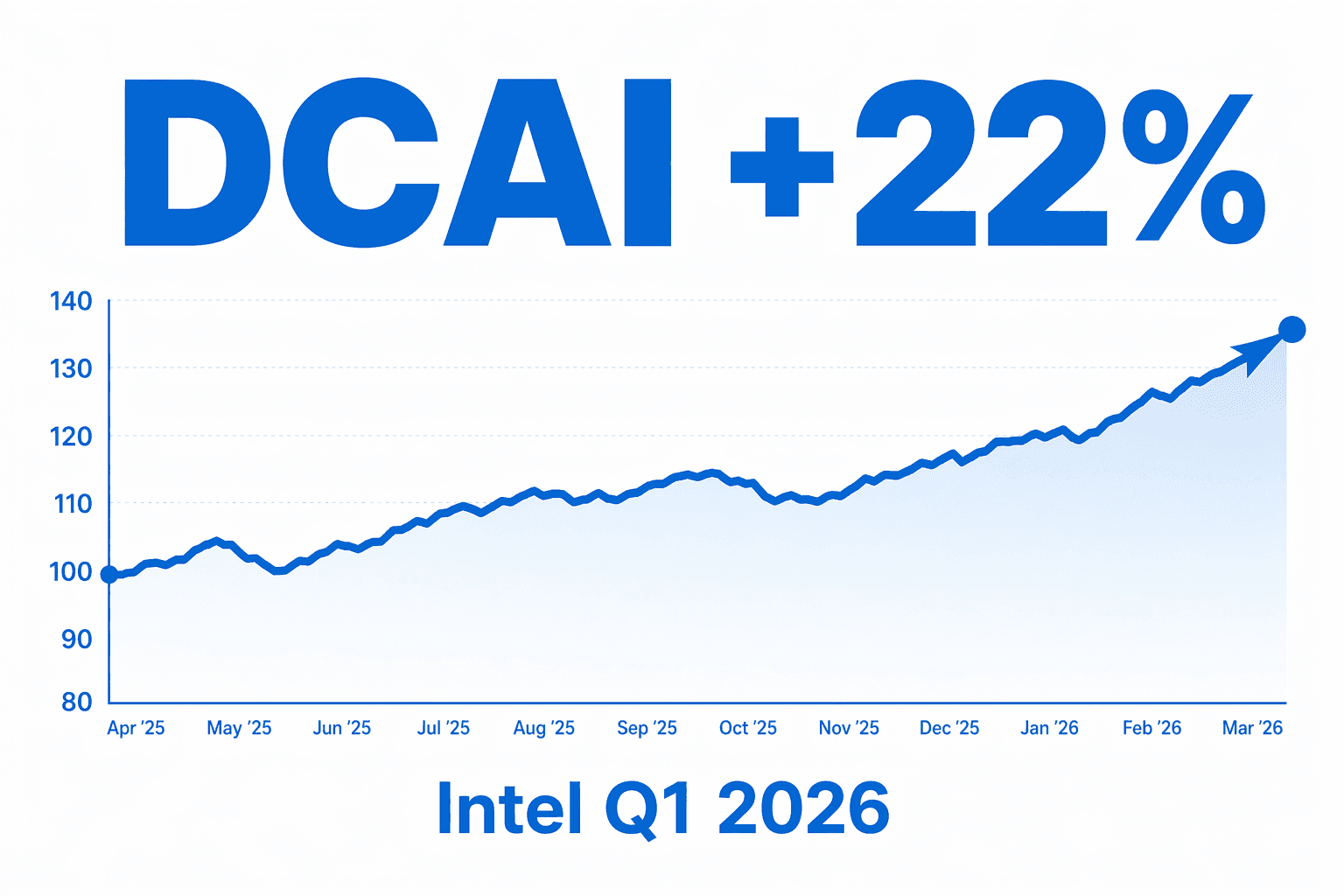
There has been a turnaround narrative building around Intel for a year. What was missing was a single, clean datapoint that made the case specific instead of generic. Q1 2026 provided it: DCAI operating margin more than doubled year-over-year, from 13.9% to 30.5%, while DCAI revenue grew 22%.
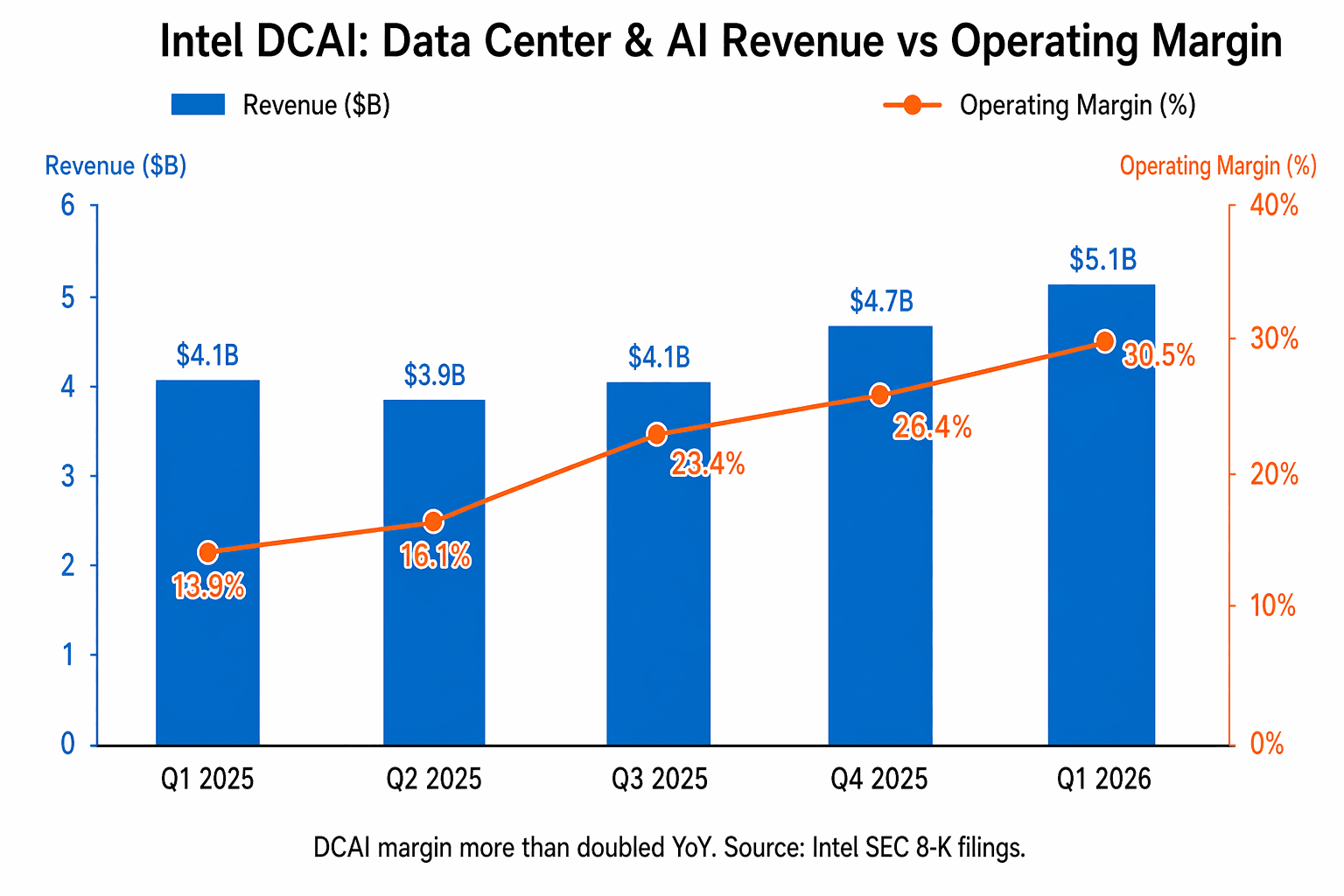
That combination — margin expanding into double-digit revenue growth — is how operating leverage actually shows up in a semis P&L. It has been the missing piece in the Intel thesis for the better part of three years. Headline revenue beats explain after-hours moves of 5%. A 20% after-hours move requires the market to re-rate the business, and re-rates happen when investors decide a variable they used to model as cyclical is actually structural.
The headline: non-GAAP margin at a four-year high
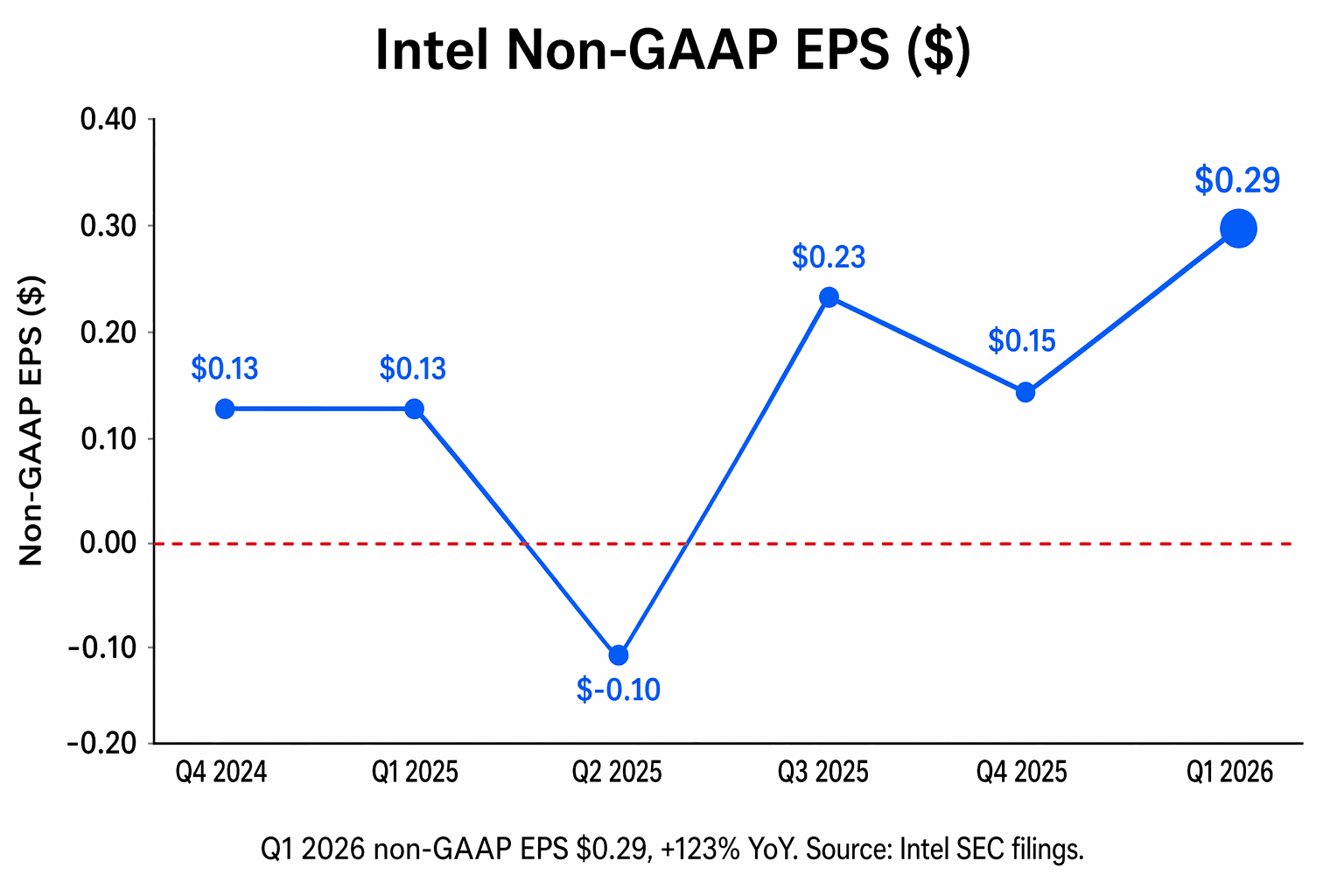
Intel posted Q1 2026 revenue of $13.58B, +7.2% year-over-year, and a non-GAAP operating margin of 12.3% — the highest quarterly print since 2021. Non-GAAP EPS of $0.29 was +123% year-over-year and more than ten times the sell-side consensus going into the print.
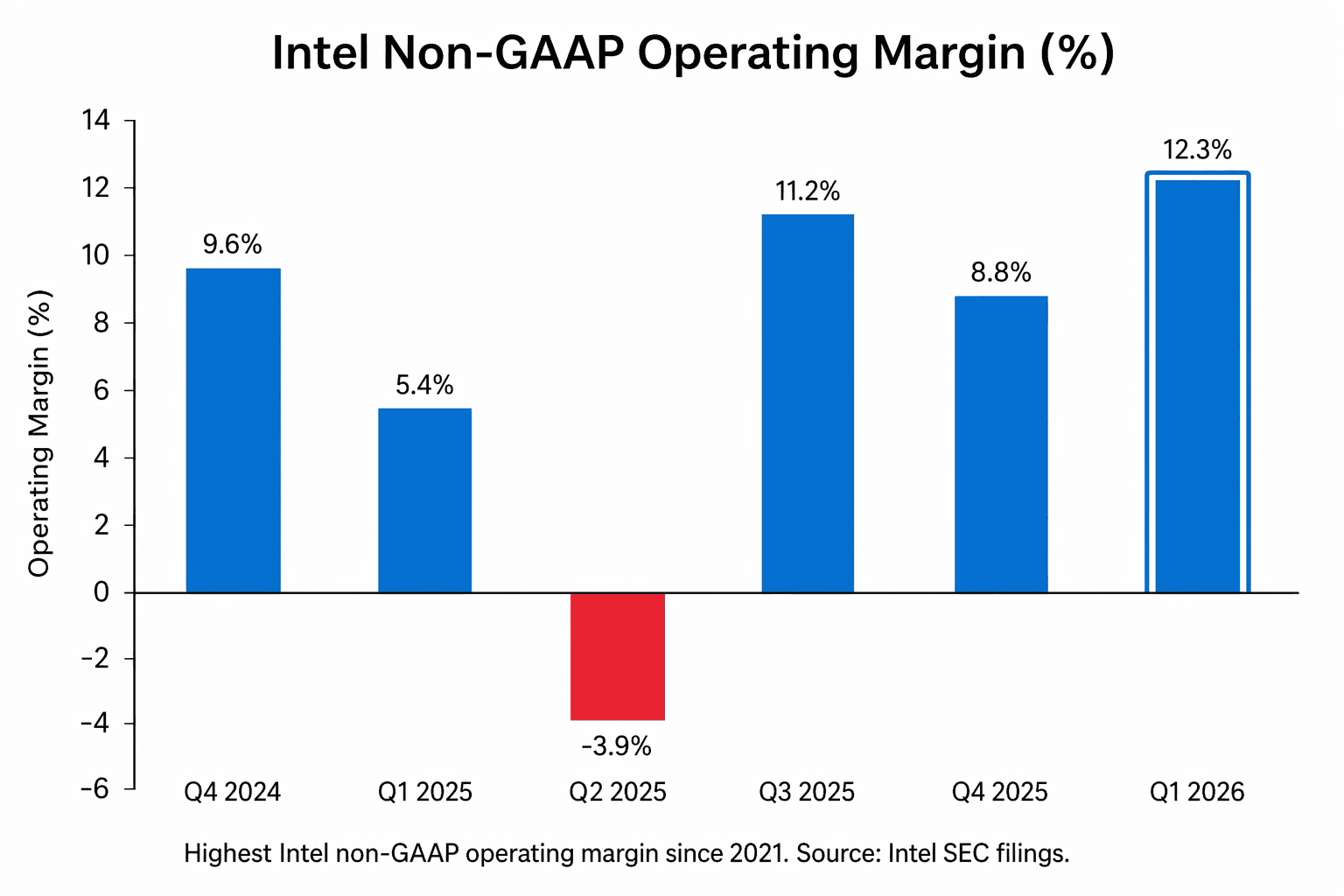
The GAAP number tells a different story — $(0.73) diluted EPS and a $(3.14)B operating loss — but that headline is swamped by a $4.07B restructuring-and-other charge that is almost entirely a non-cash goodwill impairment at the Mobileye reporting unit. That charge is an accounting consequence of Mobileye's equity valuation, not of Intel's operating business. Management characterized Mobileye's underlying quarter as "strong" and the segment's revenue was +9% sequentially.
Stripping the impairment out, the underlying operating picture is simpler: revenue accelerating, gross margin expanding, operating expenses down 8–9% year-over-year, segment margins inflecting positively — especially in DCAI — and cash plus short-term investments at $32.8B, up 56% year-over-year.
Revenue mix: Foundry at an all-time high, DCAI at +22%
Intel's segment-level revenue is where the operational pivot shows up most clearly.
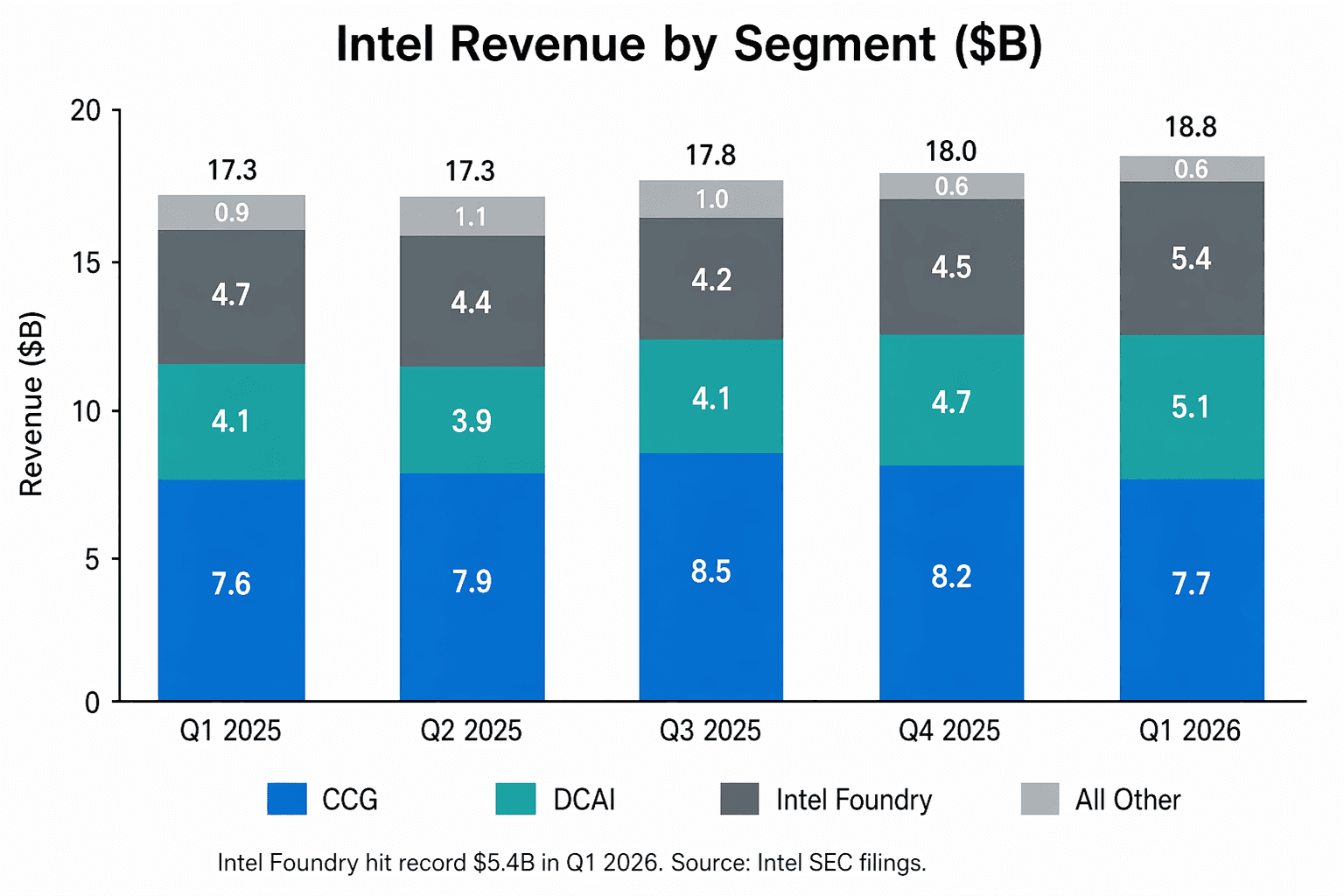
The two segments that matter most right now — and that get the most analyst attention — are DCAI and Intel Foundry. Both are growing faster than CCG (which was down sequentially on supply constraints) and All Other (which compressed mechanically after the Altera deconsolidation in September 2025).
DCAI: $5.05B revenue, +22% YoY, operating margin 30.5%. CEO Lip-Bu Tan framed the drivers as a CPU-to-GPU ratio shift — "used to be 1 to 8, now it's 1 to 4 and moving towards parity" — plus concrete hyperscaler commitments. Alphabet signed a multi-year long-term agreement covering Xeon 6 deployment across Google Cloud workload-optimized instances (C4 and N4) and co-development of a custom ASIC IPU. NVIDIA selected Xeon 6 as the host CPU for its DGX Rubin NVL8 systems. SambaNova committed to Xeon 6 as the host and action CPU inside its AI inference reference architecture.
Intel Foundry: $5.42B revenue, +20% sequentially, operating loss still $(2.44)B but no longer widening. External foundry revenue of $174M is small, but advanced-packaging demand was upgraded by the CFO from "hundreds of millions of dollars per year" to "billions of dollars per year." The first external 14A design commitments are expected to emerge in the second half of 2026 as the 14A PDK matures from 0.5 to 0.9.
The Q2 guide is what moved the stock
Intel's Q2 2026 revenue guide of $13.8B to $14.8B (midpoint $14.3B) was roughly $1.2B above the consensus sell-side model. Non-GAAP gross margin guidance of 39.0% was ~100 bps above Street. Non-GAAP EPS of $0.20 was well above the ~$0.10 consensus.
Zinsner framed Q1 2026 as Intel's lowest supply quarter of the year — "supply will go up in the second quarter, it's going to go up every quarter." He put the unmet Q1 demand at a level that "starts with a B," which — being generous but literal — means there was more than a billion dollars of revenue the company could not ship due to supply constraints. As capacity expands through 2026, that gap narrows and converts into reported revenue.
Three margin headwinds to keep in mind. First, Intel 18A volume ramps 6–7x on Panther Lake, and 18A is still below corporate-average gross margin — which is why Q2 gross margin steps down modestly from Q1. Second, capex for 2026 was revised from "flat-to-down" to "flat" vs. 2025 (with tool spending up ~25% YoY) — that is a larger capital commitment than the Street was modeling. Third, operating expenses are "directionally targeting $16B, but likely to be higher" because of inflation and variable compensation.
None of those items change the underlying thesis. They are the costs of a company that is finally making its node roadmap work and is building capacity to meet demand that is running materially ahead of supply.
Market reaction
Intel closed the regular session on 2026-04-23 at $66.78, up 2.3% on the day. In after-hours trading it traded as high as the $80–$81 range, an approximately 20% post-print move — one of the larger single-session reactions for a mega-cap semi in recent memory, and a new post-dot-com high for the stock.
Peer reaction was concentrated on the CPU complex: AMD was +5–8% and Arm was +5–6% in the extended session. NVIDIA was roughly flat (the DGX Rubin NVL8 host-CPU commentary is a positive but already-priced-in read-through). TSMC was modestly positive on Intel's explicit reaffirmation of the TSMC relationship as a "very important partner" — Intel is not walking away from the multi-foundry strategy even as it ramps its own 18A and 14A.
Forward setup
The bull case now argues three things. One, that DCAI operating margin holds above 25% — which, combined with the server CPU cycle Tan described as extending into 2027, produces mid-to-high-teens operating margin for the overall company by 2027. Two, that Intel Foundry losses peaked in Q2 2025 and the path to breakeven — while still multi-year — is no longer in doubt. Three, that the Google / NVIDIA / Terafab wins this quarter are the first in a series of multi-year external commitments that de-risk the foundry capital build.
The bear case — clearly articulated by Bernstein, Citi, Morgan Stanley, Wells Fargo — is that valuation has run ahead of execution. At ~$80, INTC trades at a multiple that assumes every one of these milestones is hit on schedule. Any slip in the 14A ramp, any weakness in the hyperscaler capex cycle, or any negative surprise on Foundry external revenue conversion can reset the stock fast. The sell-side Hold ratings are not disagreements with the beat; they are prices-not-quality calls.
What is no longer in dispute: the turnaround is real. The debate moves on from whether Intel can execute to how quickly. CEO Lip-Bu Tan put it most directly on the call: "A year ago the conversation about Intel was about whether we could survive. Today it's about how quickly we can add manufacturing capacity."