GE Vernova's Q1 2026: Orders +71%, Backlog $163B, and the $200B Target Just Moved Forward a Year
The backlog just moved forward a year
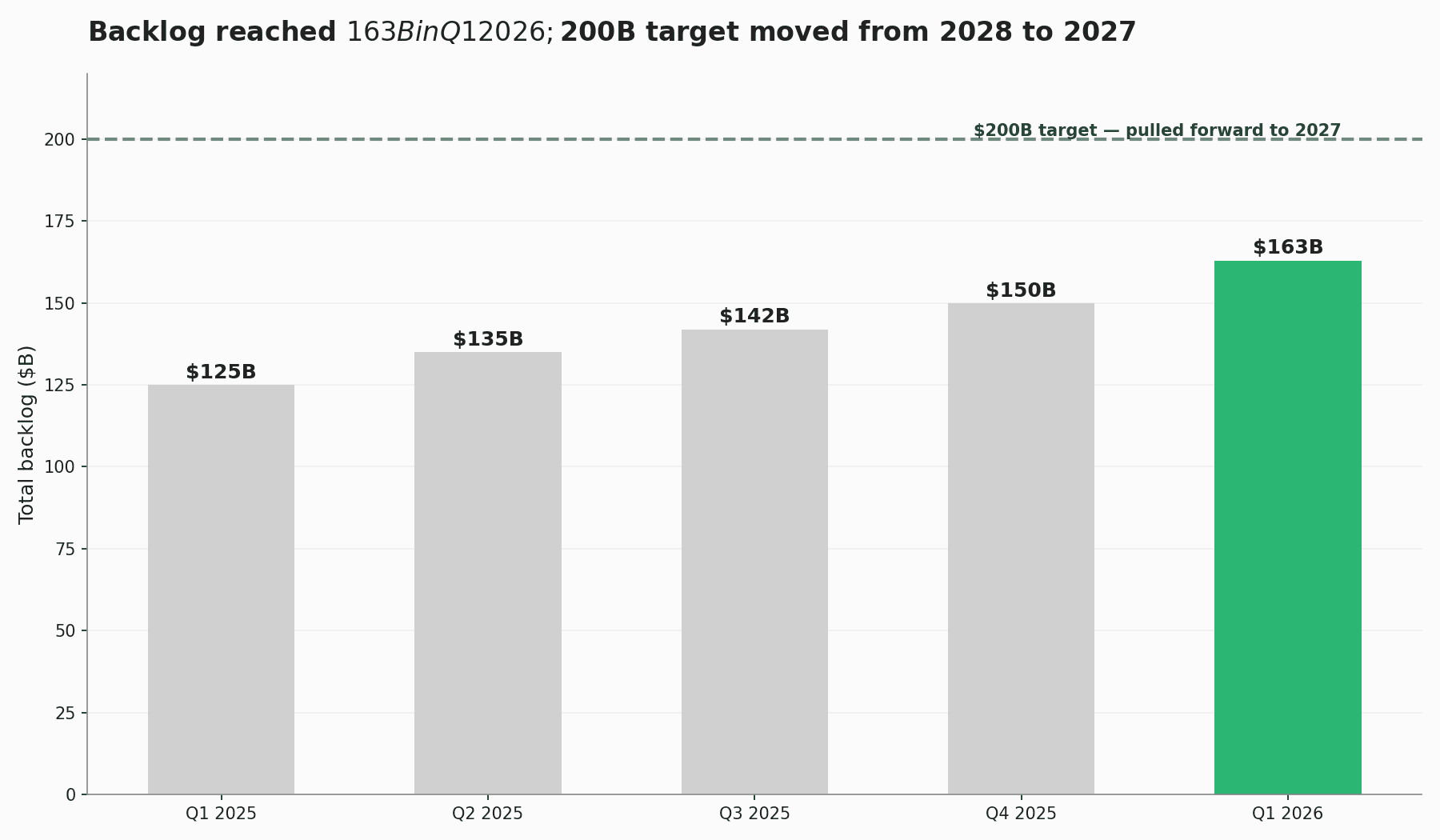
Start with the number that will matter most when this quarter is remembered: the $200B backlog target was pulled forward from 2028 to 2027. CEO Scott Strazik, on the earnings call: "What we told you would arrive in 2028, we now expect in 2027. The backlog growth is not an accident — it's a demand curve meeting our capacity curve."
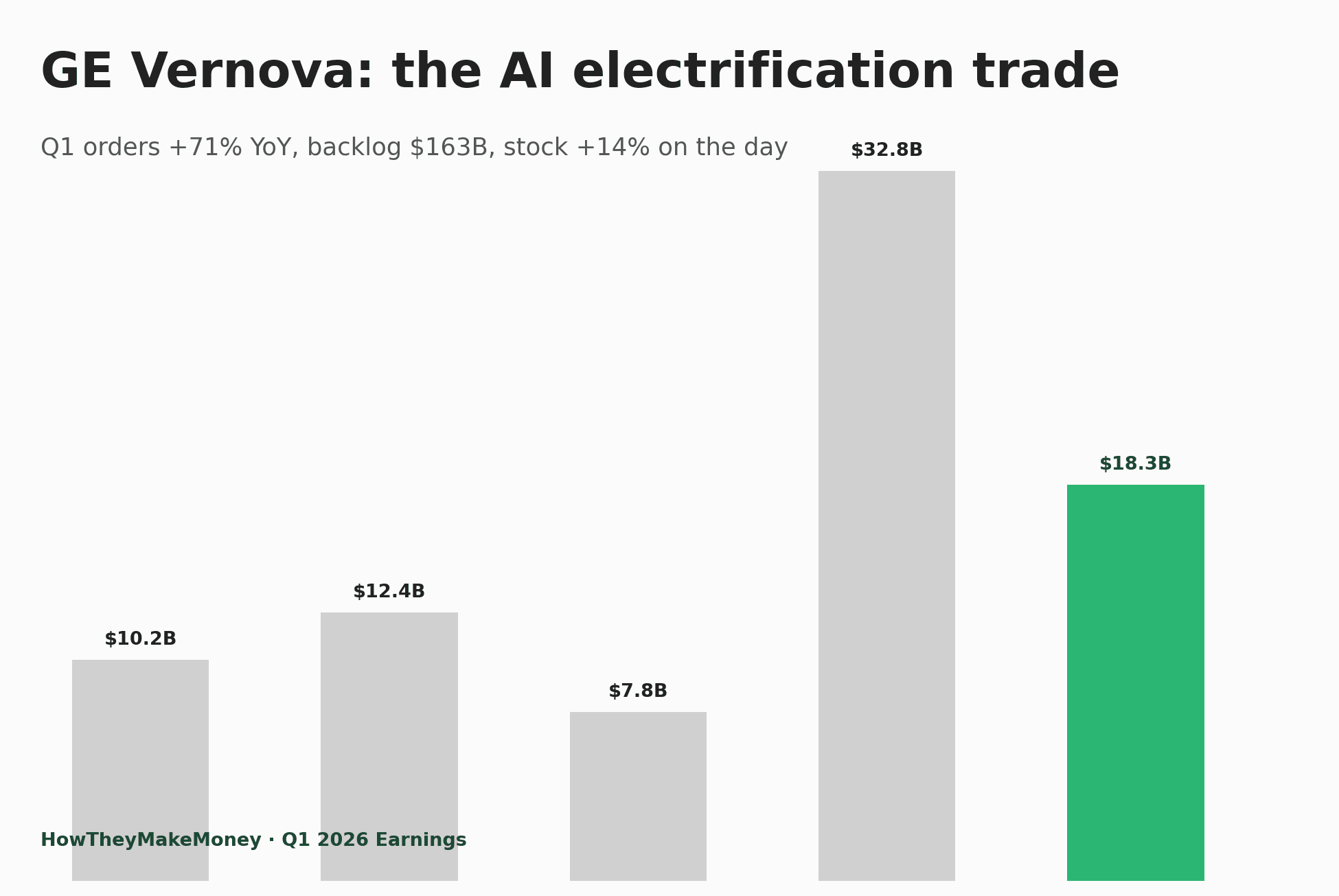
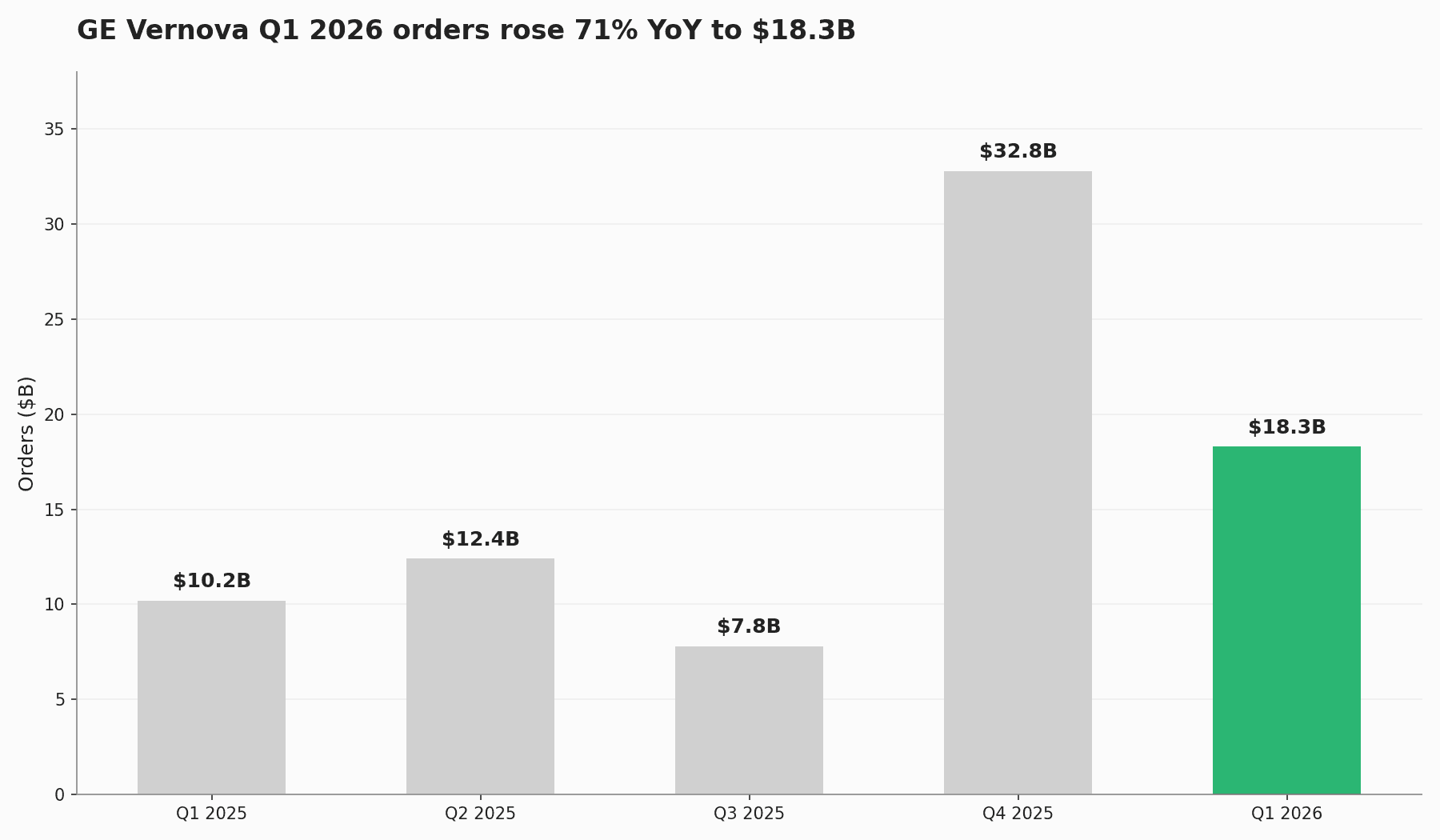
Q1 2026 orders came in at $18.3B, +71% YoY, versus the Street modeling roughly $13B. The sequential drop from Q4 2025's $32.8B looks dramatic, but Q4 was distorted by a single bundled multi-year gas turbine order book worth roughly $10B. Normalized, Q1's run-rate order intake is the cleanest read on the underlying demand trajectory — and that trajectory is still accelerating.
Total backlog reached $163B, with equipment backlog up ~80% since the April 2024 spin. To put that in context: in the two years since GE Vernova became a standalone public company, its equipment book has nearly doubled, and the ratio of equipment-to-services backlog has inverted. Two years ago, services dominated. Today, equipment is the lead and services is the annuity.
Power margins just printed a cycle-high
The second surprise of the print, and the one that convinced the sell side to lift price targets by a median 12%, was segment margin performance.
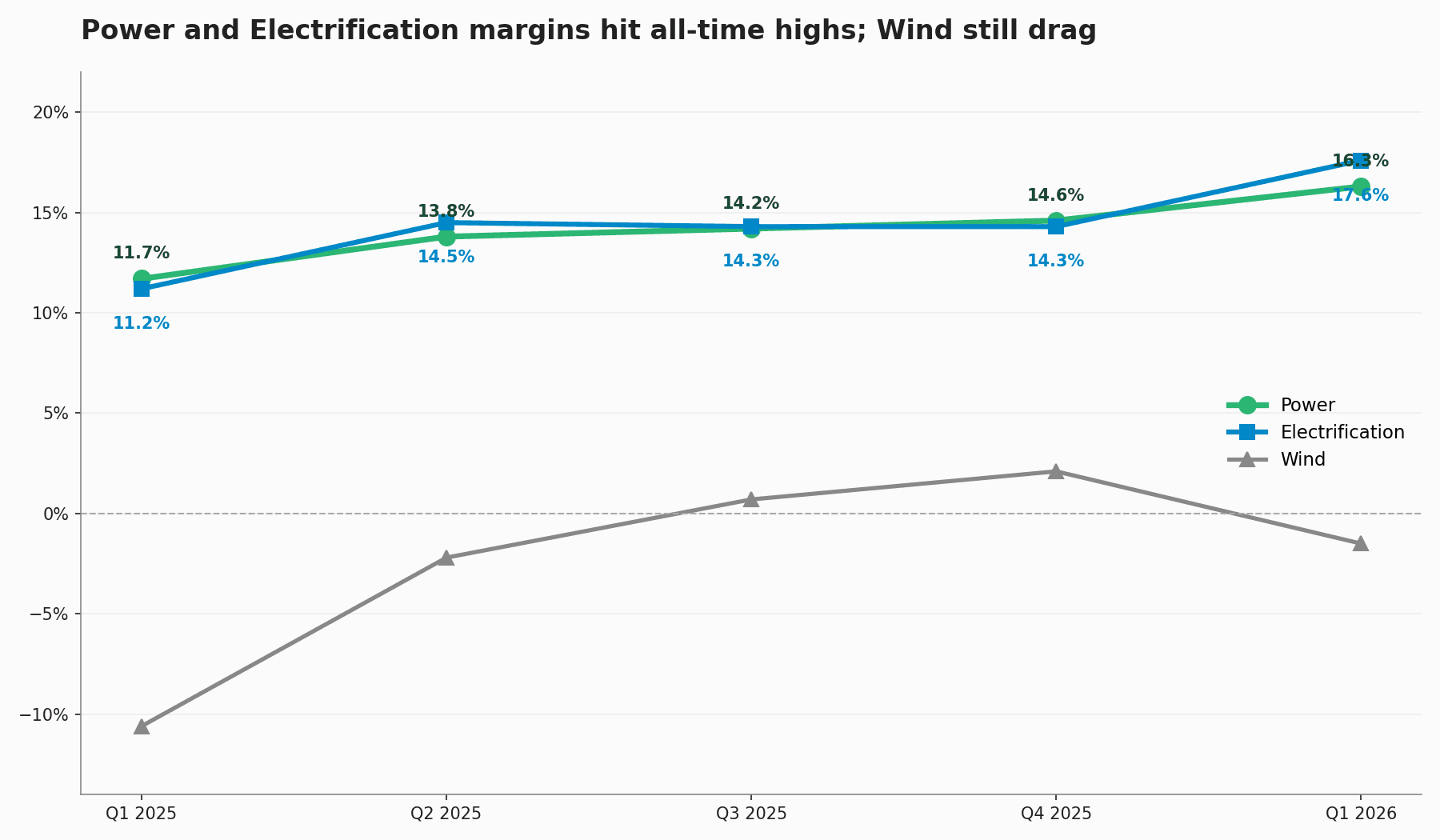
Power segment EBITDA margin expanded to 16.3%, a 470 bps YoY gain and the highest quarterly print since the spin. Electrification margin expanded 640 bps YoY to 17.6% — led by full-quarter contribution from Prolec GE at >20% EBITDA margin, plus absorption leverage on grid equipment volumes.
What makes the margin story credible, not just a one-quarter spike: management raised the full-year Power segment EBITDA margin guide to 17–19% (from 14–16% prior), and raised the full-year consolidated adjusted EBITDA margin guide to 12–14% (from 11–13%). Both raises were 100 bps+ at the midpoint. CFO Ken Parks attributed the margin durability to three factors: pricing power on new gas turbine orders (priced at roughly 30% premium to 2022 vintage), mix shift toward higher-margin services, and locked-in input costs on >70% of the 2026 backlog.
Data-center orders are now the lead indicator
The single most-cited datapoint in post-earnings coverage was $2.4B of Electrification orders tied to data-center customers in Q1 2026 — exceeding all of 2025's data-center order intake. This is the underlying force behind the margin story and the backlog pull-forward.
The mechanics are simple: hyperscaler capex for AI training clusters has outgrown the pace at which US utilities can build new generation and transmission. The result is a multi-year scramble for (a) new gas turbines, (b) transformers and medium-voltage switchgear, (c) grid stability equipment, and (d) nuclear options. GE Vernova is one of the only companies in the world that supplies all three of (a), (b), and (c) at scale. Competing positions — Siemens Energy, Mitsubishi Heavy Industries, and to a lesser extent Bloom Energy — each own parts of the stack, but not the full set.
Gas turbine backlog ended Q1 at 44 GW; slot reservations add another 12 GW for 56 GW combined. Strazik's stated year-end target is ~110 GW combined — implying that roughly another 50+ GW of slot reservations convert or new orders close in the next nine months. Historical reservation-to-firm conversion runs at ~75%, so there is a credible path.
Free cash flow was the quieter beat
Operating cash flow was $5.1B; capex of $300M took free cash flow to $4.8B — more than 4x the $1.05B prior-year quarter. Parks attributed it to milestone-billing timing on gas turbine orders plus disciplined working-capital management. The full-year FCF guide was raised to $6.5–$7.5B (from $5.5–$7.0B), a $750M midpoint raise.
The cash generation profile has become the part of the story that changes how investors value GEV. With $8.85B of cash on hand and FY26 FCF now guided to $7B at the midpoint, management has meaningful optionality: finish the gas turbine capacity expansion (Greenville, SC + Belfort, France), continue opportunistic bolt-on M&A in grid software and transformers, and accelerate buybacks. Current buyback authorization has ~$1.7B remaining.
The one weak spot: Wind
Wind segment revenue was $1.34B, -23.4% YoY and -52% QoQ. Wind EBITDA was -$20M — a meaningful +$165M improvement YoY but a sequential step back from the small Q4 2025 positive print. Onshore wind installation volume was only 650 MW, the lowest quarterly print in over a year.
Management's framing on offshore wind remains cautious: "We continue to be cautious on offshore wind in the US for 2026–2027. Our team is focused on execution of the existing contracted backlog rather than chasing new book." For practical purposes, bulls are modeling Wind as a zero-EBITDA stub for the next two years — any improvement would be incremental upside.
Analyst reaction: price targets up across the board
Twenty-four of 29 sell-side analysts raised their 12-month price target on April 22–23. Median PT cut was +12%. Consensus now sits at ~$1,020 versus pre-print ~$915. The biggest movers: JPMorgan $1,000 → $1,150 (top of the Street), Barclays $849 → $993, Morgan Stanley $817 → $960.
The one cautious voice worth noting is BTIG at Hold with a $780 PT — the argument is purely valuation: GEV trades at approximately 25x FY26 EBITDA versus industrial peer average of 14–16x. That premium is defensible only if the 2–3 year data-center order visibility holds. If hyperscaler capex resets (which happens in most tech cycles eventually), the multiple compresses fast.
Forward setup
What I will be watching into Q2 2026:
- Slot reservation → firm order conversion rate. The 110 GW year-end target requires ~50+ GW of net adds from the current 56 GW base. Q2's gas turbine order disclosure will be the single most important operational number.
- Electrification data-center order momentum. Q1 booked $2.4B. Can Q2 match or exceed, or was Q1 front-loaded by a handful of large customer contracts?
- Gas turbine pricing durability. Is the 30% premium to 2022 vintage sustainable once Siemens Energy and Mitsubishi Heavy Industries complete their own capacity expansions in 2027?
- Wind Q2 commentary. No one is expecting Wind to turn around in 2026, but any language softening on "no new offshore book" would be a positive signal.
- Capital allocation. With $8.85B cash and ~$7B of FY26 FCF coming, does management accelerate the buyback, announce a dividend initiation, or preserve dry powder for large M&A?
For now, the market's reaction is unambiguous: +13.6% on the day, a new all-time closing high of $1,126, and the cleanest single-day move for GEV since the spin. The AI electrification trade got another quarter's worth of fundamental validation. The question the next two quarters will have to answer is whether this is still early innings of a decade-long power capex super-cycle — or whether the premium multiple is about to meet a pricing correction.